
Nepal is one of the few places in the world where deities are not only worshipped through idols and scriptures but are also believed to live in human form. This centuries-old tradition of worshipping living gods is still practised today, though it is gradually changing in response to modern realities without discarding its fundamental beliefs.
Living gods are rooted in the belief that divine energy can temporarily enter a human body. This belief stems from both Hinduism and Buddhism. Communities have blended these two religions, with deities such as Taleju being venerated by both Hindus and Buddhists, and rituals incorporating elements of both faiths.
Living gods are rooted in the belief that divine energy can temporarily enter a human body.
This belief system is further shaped by the traditions of the living goddess Kumari and the living male gods Ganesh and Bhairav. They are considered divine by many communities, particularly the Newa community of the Kathmandu Valley.
Kumari: The Living Goddess
The most famous living deity, the Kumari, is regarded as the human manifestation of the goddess Taleju, traditionally revered as the protector of the Malla kings. The origins of this tradition can be traced to the medieval period, when rulers sought divine permission and protection by establishing a direct connection with the goddess. Over time, the position of the Kumari became a permanent institution, continuing even after the demise of the monarchy.
The Kumari is chosen at a very young age, typically between two and four years old. She must belong to certain Newar Buddhist families, traditionally the Shakya or Bajracharya lineages. The selection process is rigorous and highly ritualised, involving physical, astrological, and psychological tests designed to assess fearlessness and emotional stability. The belief is that the goddess will only reside in a body that is physically flawless and emotionally calm.
Once selected, the Kumari leaves her family home and begins living in the Kumari Ghar, most famously located in Kathmandu Durbar Square. From that point onwards, her daily life changes entirely. She wears ceremonial clothing, her movements are restricted, and her public appearances are strictly regulated. During major festivals, she is carried so that her feet do not touch the ground. This physical separation reinforces her divine status and contrasts with ordinary human life.
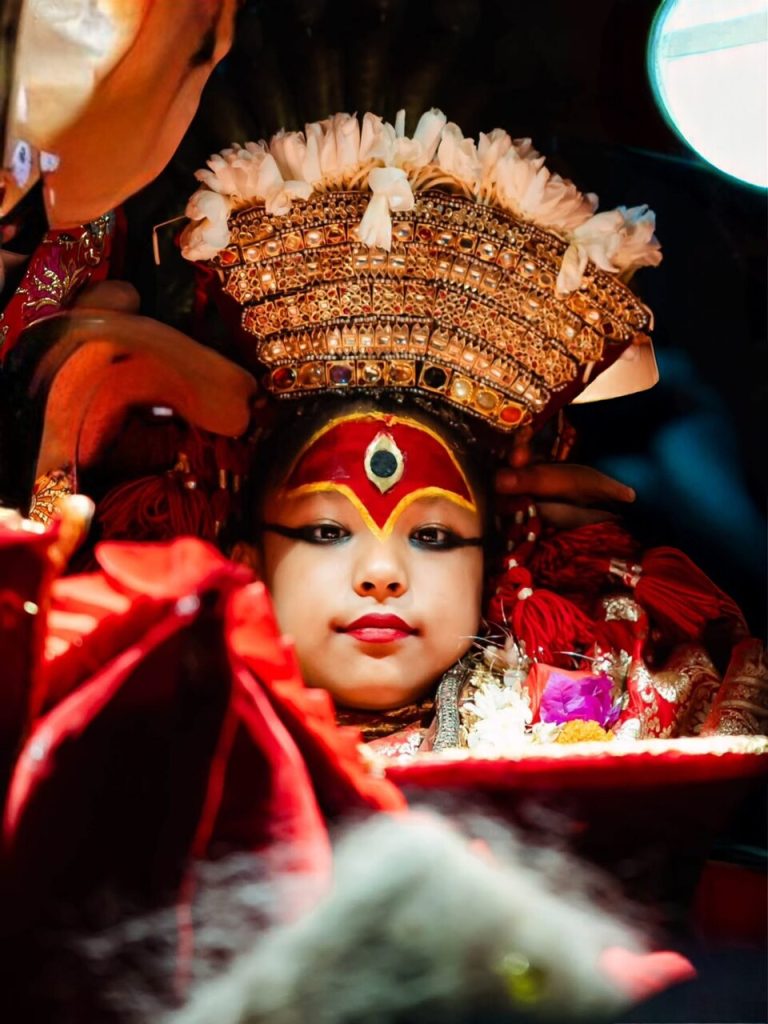
The Kumari is not entirely isolated, as is often assumed. In recent decades, she has been able to receive education within the home, socialise with caretakers, and maintain contact with family members. The role ends at puberty or in the event of significant bleeding, which is believed to signal the goddess leaving her body. After this, she returns to ordinary life. This transition can be challenging, as former Kumaris must adjust from a life of worship to everyday social realities. To support this shift, the Nepali state provides financial assistance and educational opportunities to former Kumaris.
Despite receiving the most attention, the Kathmandu Kumari is not the only living goddess in Nepal. The tradition is practised in several towns within and beyond the Kathmandu Valley, particularly in areas with large Newa populations. Patan and Bhaktapur each have their own Kumari, who serve their local communities and participate in local festivals. Kumaris can also be found in Nuwakot, Bungmati, and Thimi.
These Kumaris follow the same principles but operate on a smaller scale. Their appearances are usually limited to local festivals, and they do not receive the same national or international attention as the Kathmandu Kumari. Nevertheless, they hold equal religious significance within their communities.
Ganesh and Bhairav: The Living Gods
The Kumari is not the only living deity. Male gods—most prominently Ganesh and Bhairav—are also recognised as living deities. These roles are less widely discussed but remain essential to the system of living deities in the Kathmandu Valley. Like the Kumari, these deities are embodied by young children, typically Newar boys, selected based on ritual and lineage requirements.
The selected children who embody Ganesh and Bhairav are revered during rituals, yet they continue to live with their families and attend school. They are primarily seen during festivals alongside the Kumari.
These deities appear during major festivals such as Indra Jatra, where they participate in chariot processions with the Kumari. Together, the three figures represent a balance of divine forces: the Kumari as supreme divine power, Ganesh as wisdom and the remover of obstacles, and Bhairav as both protector and punisher.
When a child grows older or no longer meets ritual requirements, he is replaced by another. This reinforces the belief that divinity does not permanently transform individuals but flows through them temporarily.
The worship of Ganesh and Bhairav in human form is limited to Kathmandu and does not extend to other places where the Kumari tradition exists, such as Patan, Nuwakot, and Bhaktapur. The selection process closely mirrors that of the Kumari. Unlike her, however, these boys are allowed to live largely ordinary lives, appearing only during major festivals. Despite holding equal divine status, they often receive far less public attention. While the Kumari is regarded as a royal goddess, Ganesh and Bhairav are primarily seen as protectors against various evils.
The tradition of living gods offers a tangible connection between people and their beliefs. For many devotees, encountering a living deity feels more immediate than worshipping a distant or abstract god.
While these practices continue to evolve through education, state involvement, and changing social values, their core belief remains unchanged: divinity is present and visible. In this way, Nepal’s living deities continue to exist between tradition and modern life.
Pratikshhya Bhatta is a junior editor with Nepal Connect.