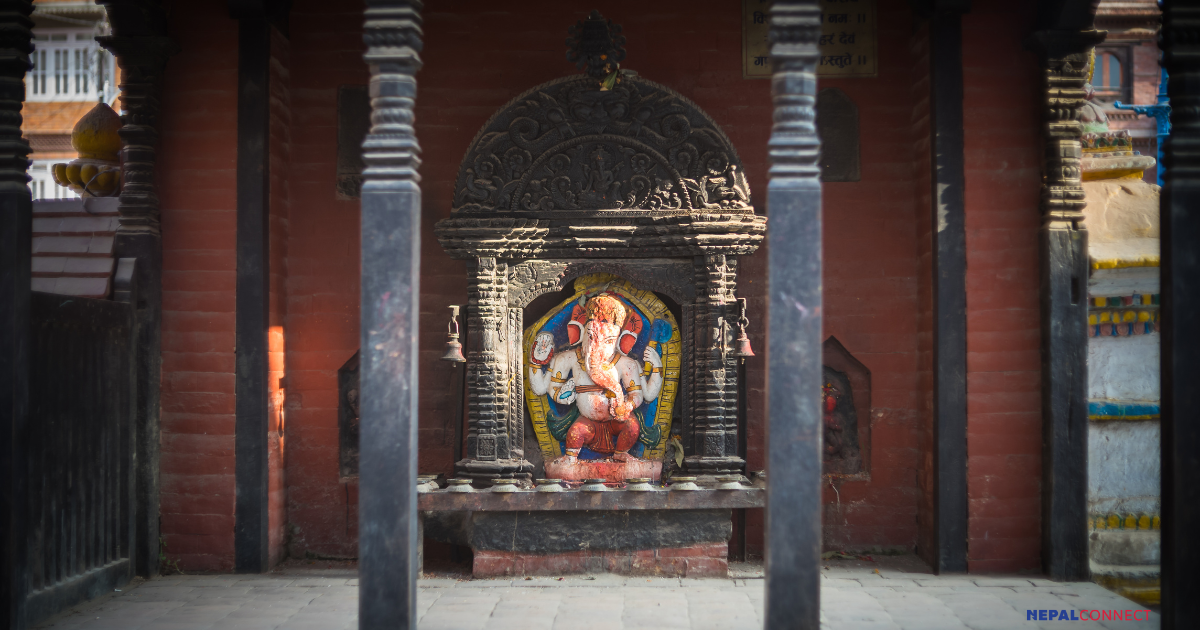
In Patan, it is almost impossible to stroll through a neighbourhood without encountering an idol of Lord Ganesha. Depicted with an elephant head, Lord Ganesha is revered as the deity of prosperity and as one who removes obstacles.
While there are millions of deities in Hinduism, every pooja ritual starts with worshipping Lord Ganesha. The story of Ganesha begins under unusual circumstances. In one version of the tale, Parvati created Ganesha from her essence to guard her. Shiva accidentally decapitated Ganesha, unaware he was attacking his son.
Realising his mistake, Shiva revived Ganesha and replaced his head with an elephant’s. This exchange symbolised transition and transformation, and Ganesha became the Elephant Deity. From then on, he was blessed to be worshipped first in all ceremonies.
Ganesha in Patan and Newa Traditions
In Patan, the Kaina Puja, a worship of Lord Ganesh, is essential for the successful completion of any festival or ritual. This puja is even performed after the Rato Machindranath Jatra.
“Lord Ganesh is Patan’s main deity, with idols in every neighbourhood; their numbers are even listed,” says Suprince Shakya, a cultural practitioner in Patan who performs various ancient dances.
The most Ganesh Pujas occur during the Mataya Festival, a day-long Buddhist and Newa festival held after Gai Jatra. This festival honours the deceased, guiding their souls with lamps and prayers. As part of the worship, even household Ganesh shrines are carried around Patan at the festival’s conclusion.
One thing to remember while worshipping Ganesha is to never offer him Tulsi (holy basil). Tulsi is revered as a goddess and is believed to be a form of Goddess Lakshmi. According to legend, she once proposed marriage to Ganesha. Because he had taken a vow of celibacy, he refused. Angered, Tulsi cursed him to marry two wives. In return, Ganesha cursed her to be married to a demon. Since then, Tulsi leaves are not offered to Lord Ganesha.
Names, Symbolism, and Belief
The deity is known by 108 different names, each representing a unique aspect of him. Some popular ones include Vighnaharta (Remover of Obstacles), Lambodara (The Big-Bellied One), Ekadanta (The One-Tusked), and Vinayaka (The Leader). He also rides a tiny mouse, Mushaka.
Many people pray to him as they begin significant activities in life, since the god is believed to grant easy passage. His influence is not confined to the physical realm; it also guides spiritual growth by helping eliminate mental barriers that prevent growth and awakening. Devotees worldwide recite the prayer “Om Gam Ganapataye Namaha”—“I offer my obeisances to Ganesha, the remover of obstacles.”
Ganesha Chaturthi, a major 10-day festival, celebrates the birth of Ganesha, the remover of obstacles. Festivities include installing Ganesha idols in homes and public pandals, daily prayers with offerings like modak, and grand processions for idol immersion (Visarjan), symbolising the cycle of creation and dissolution.
Also worshipped as the lord of knowledge and the guardian of the sacred, he is described as having written the great epic Mahabharata for the sage Vyasa, using his tusk like a pen.
He has large ears symbolising listening and a round belly representing generosity and acceptance. His four arms embody mind, intellect, ego, and self. His vehicle, the mouse, symbolises the taming of a small yet potentially destructive, active mind.
Lord Ganesha’s form, with his trunk raised to his mouth and the humble mouse at his side, embodies coexistence between humans, animals, and nature. His story teaches that endings, though painful, are transitions to new beginnings.
Pratikshya Bhatta is a junior editor with Nepal Connect.