
Support independent and reliable information and inspiration
about the development of Nepal at €10, €20, €30 per month

Advertisement

WORK IN PROGRESS

  • Login
  • Register
SUBSCRIBE
NepalConnect
  • DIGEST
    • CURRENT AFFAIRS
    • DEVELOPMENT
    • DISCOVERY & TRAVEL
    • IN-DEPTH
  • FEATURES
  • LIBRARY
  • TRAVEL DESK
  • DIRECTORY
No Result
View All Result
  • DEVELOPMENT
  • CURRENT AFFAIRS
  • TRAVEL & DISCOVER
  • IN-DEPTH
NepalConnect
  • DIGEST
    • CURRENT AFFAIRS
    • DEVELOPMENT
    • DISCOVERY & TRAVEL
    • IN-DEPTH
  • FEATURES
  • LIBRARY
  • TRAVEL DESK
  • DIRECTORY
No Result
View All Result
NepalConnect
No Result
View All Result
Home Digest CURRENT AFFAIRS Malpractices
Meter Byaj and the Urgent Need for Financial Reform  

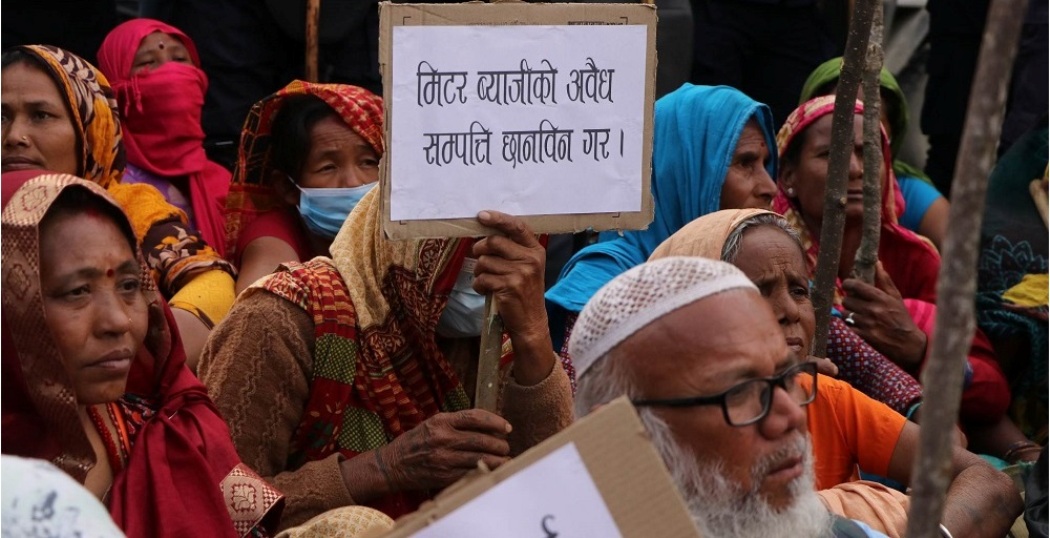
Photo: The Rising Nepal

Meter Byaj and the Urgent Need for Financial Reform  

Sudipa Mahatoby Sudipa Mahato
December 1, 2025
in Malpractices
0

“Meter byaj”, a fraudulent lending practice, is a significant financial hardship for many Nepali families, particularly in rural areas lacking access to formal banking. Moneylenders often prey on vulnerable borrowers, charging such extreme interest rates that debts rise as fast as a spinning taxi meter. 

Informal lenders have always existed, but the scale of their influence recently is worrying. They can charge as high as 36 per cen to 120 per cent per annum, which is much higher than the legal maximum of 10 per cent per annum for personal loans. 

This method of interest rates is designed to trap borrowers in a cycle of debt, where even paying off the principal amount doesn’t seem to reduce the total debt, and at times interest is more than the initial principal.  

These loan sharks often exploit the desperation of borrowers who have no other financial options. Villagers, particularly those in rural areas, lack access to formal financial institutions. Desperate individuals often turn to loan sharks, and financial illiteracy makes them vulnerable to exploitation due to a lack of understanding of complex loan terms. 

Intimidation is another layer of the issue. Some lenders resort to using threats, pressure, or even physical force to ensure submission and repayment. Many families continue living in constant fear not only of rising debt but also of the possibility of further escalation.  

Government Response  

In 2024, responding to growing concerns, the Home Ministry formed a task force under Joint Secretary Bhisma Bhusal to investigate illegal lending networks by visiting affected districts and interviewing victims. 

Despite the governmental effort, many households remain sceptical, as they have previously seen similar investigations and committees that produced reports but failed to dismantle the actual system that traps them.  

In March 2024, after weeks of intense protest from over 1200 victims from 28 districts, the government and usury victims reached a significant four-point agreement after negotiations. A new three-member inquiry commission was formed to examine forged loan documents, illegal interest rates, and other exploitative practices. 

Following the agreement, protest groups then halted their demonstrations. This initiative was signed in the presence of Deputy Prime Minister and Home Minister Rabi Lamichhane. However, it wasn’t the first such attempt.   

In an earlier attempt, the commission led by former judge Gauri Bahadur Karki had already resolved several hundred cases. Yet the issue persists, which suggests that simply settling individual disputes is not enough to dismantle the broader ecosystem that enables loan sharking.  

“The government needs to ensure that local governments provide mechanisms to regulate small loans, and penalties should be imposed on those who exploit vulnerable borrowers,” says Achyut Wagle, economist and Vice-Chancellor at Kathmandu University. 

Formal financial services are lacking in rural areas, making grassroots efforts crucial. 

Structural Problems and Long-Term Solutions 

Limited access to urban-centric banks and cooperatives forces many rural residents to rely on informal lenders, increasing their risk of debt and highlighting inequities in the nation’s financial infrastructure. 

The government needs to set an upper limit on interest rates in rural areas and work towards cracking down on loan sharks. It is equally necessary to provide financial education programmes to help borrowers better understand the terms and provide them with relevant alternatives to reduce such associated risks.  

The government could also regulate small retail loans in rural areas and protect victims from predatory lending. 

“It is crucial that we penalise erring parties in a way that sets a precedent and forces us to change,” says Wagle.  

A Call for Reform 

There is an urgent need to reform the financial sector. While commissions have offered some justice, rampant corruption and legal loopholes continue to plague the system. 

Without meaningful reform, loan shark victims will continue to suffer, and the issue, though currently under control, will likely reemerge in a few years without a sustainable solution. 

The government needs to take decisive action to protect its citizens from loan sharks and provide access to fair and regulated financial services.  


Sudipa Mahato is a junior editor with Nepal Connect.  

Tags: Loan shark victims in NepalMeter Byaj

Related Posts

The Cooperative Scams

The Cooperative Scams

August 16, 2024
3.5k
Sudipa Mahato

Sudipa Mahato

Leave a Reply Cancel reply

Your email address will not be published. Required fields are marked *

Nepal Connect
SECTIONS
  • Digest
  • Features
  • Library
  • Travel Desk
  • Directory
NEPAL CONNECT
  • Mission
  • Colophon
  • Profile
  • Foundation
  • Executive organization
  • Ambassadors
  • Workshops
PARTICIPATION
  • Volunteer/ Intern
  • Research
  • Guest writer
  • Work With Us
  • Test Readers
  • Study Group
SUPPORT
  • Nepal Patrons
  • Project Support
  • Support Journalism
ACCOUNT
  • Sign Up
  • Subscribe
  • Manage My Account
  • Directory
  • Gift Subscriptions
  • Group Subscriptions
  • Gift Articles
  • Email Newsletters
  • Email Alerts
  • Advertiser
  • Customer Service
  • Directory Deal
  • Contact Us
  • Terms & Policy
  • Site Map
FOLLOW US

Welcome Back!

Sign In with Facebook
Sign In with Google
OR

Login to your account below

Forgotten Password? Sign Up

Create New Account!

Sign Up with Facebook
Sign Up with Google
OR

Fill the forms below to register

All fields are required. Log In

Retrieve your password

Please enter your username or email address to reset your password.

Log In
  • Login
  • Sign Up
  • DIGEST
    • DEVELOPMENT
    • CURRENT AFFAIRS
    • DISCOVERY TRAVEL
    • IN-DEPTH
  • FEATURES
  • LIBRARY
  • TRAVEL DESK
  • DIRECTORY
  • MISSION
  • COLOPHON
  • PROFILE
    • Participation
    • Support
    • Accounts
    • Advertisers
    • Contacts us
  • FOUNDATION
  • EXECUTIVE ORGANIZATION
  • AMBASSADORS
  • WORKSHOPS
  • VOLUNTEER/ INTERN
  • RESEARCH
  • GUEST WRITER
  • WORK WITH US
  • TEST READERS

Copyright © 2023 NepalConnect. All rights reserved.