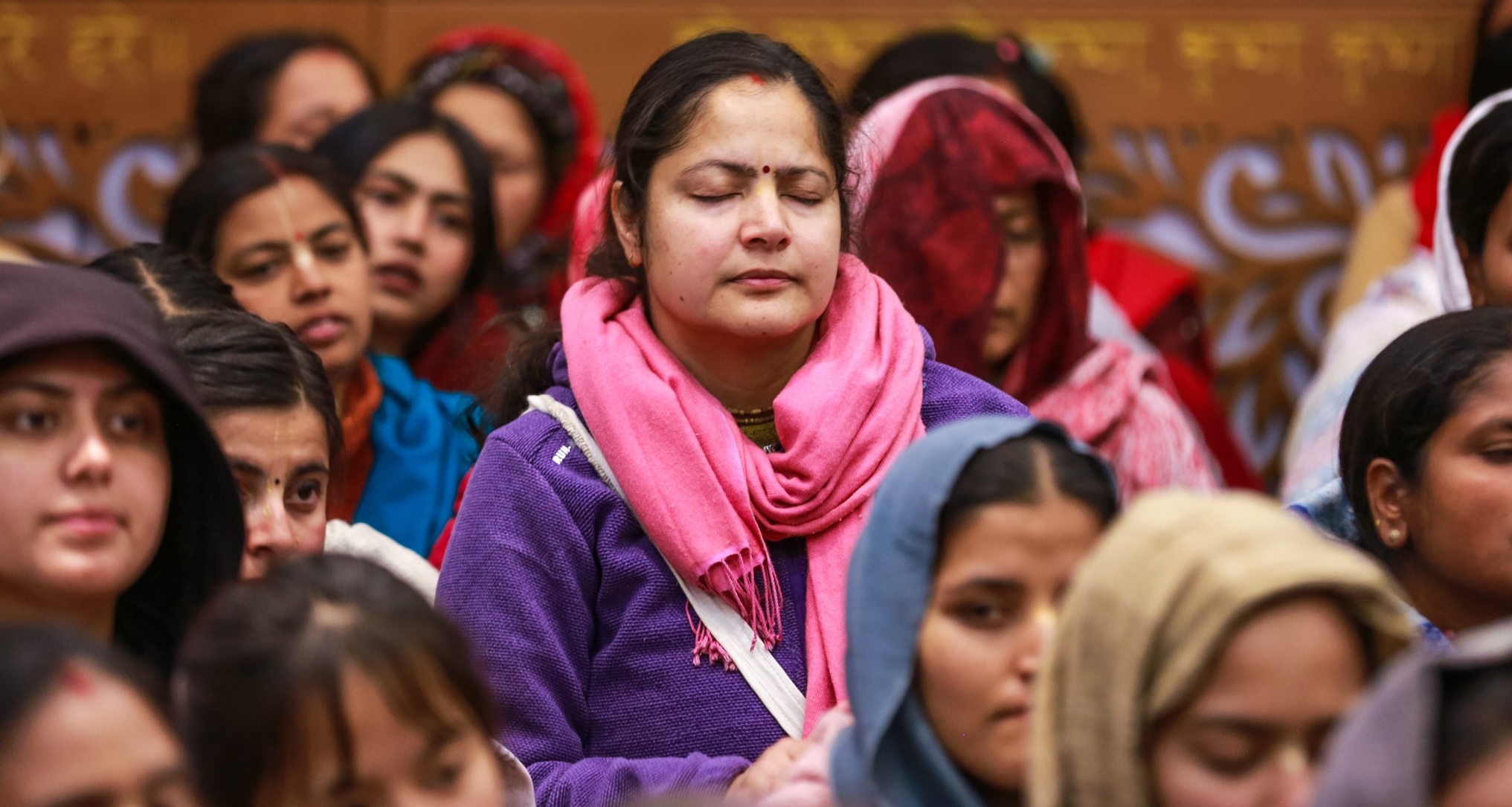

In the evenings, at heritage sites in Kathmandu, one might see a group of foreigners dressed in traditional attire singing bhajans, chanting Hare Krishna, dancing, and inviting others to join in.
The International Society for Krishna Consciousness (ISKCON) is the organisation responsible for these activities. Although it is not new to Nepal, its recent public prominence certainly is.
Into ISKCON
ISKCON was established in 1966 in New York by Swami Prabhupada. He followed Vaishnavism, a branch of Hinduism focused on devotion to Vishnu and his avatars, primarily Krishna, through chanting and studying scriptures. A key practice is singing the names and sacred phrases connected with a deity.
Prabhupada was a spiritual and philosophical teacher from India who propagated Krishna consciousness around the world. He travelled to New York City in 1965 at the age of 69 to share these teachings.
Although its philosophical roots lie in the Indian subcontinent, ISKCON initially expanded in Western countries. This expansion has now come full circle. Devotees from Western nations are active in South Asia, including Nepal, where they engage in preaching, teaching, and community activities.
According to Nirmala Mani Adhikary, a prominent author and communication theorist, this “reverse trend” is an important part of ISKCON’s growth. Previously, the movement expanded from India to the West. Now, individuals from those Western communities have become practitioners and, in some cases, spiritual leaders accepted by followers in countries like Nepal. This challenges assumptions that Hindu traditions are limited by geography, caste, or birth.
In the Vedantic tradition, the Upanishads, the Brahmasutra, and the Geeta are regarded as the principal texts. Among them, the Geeta is widely followed, and ISKCON focuses on its dissemination. Another major emphasis is on devotional practice. Chanting the Hare Krishna mantra is seen as a primary route to salvation, particularly in the current age, often called Kali Yuga.
The Nepali Appeal
During the 1970s, along the Hippie Trail, Nepal had already established itself as a destination for exploration and alternative lifestyles. Its diverse geography and culture offered a unique experience for those seeking change. Many who wished to live more freely found a sense of welcome.
Openness remains a crucial factor. Adhikary highlights that people join ISKCON regardless of nationality, ethnicity, race, language, and social status. This is important in a society where religion is often connected to family and community background.
He mentions that this is a new approach for those who saw Hinduism as a closed system based on birth, caste, and varna. In contrast, ISKCON presents itself as open to anyone willing to participate.
This helps clarify its appeal to foreigners. ISKCON provides a structured way to engage with Hindu philosophy through practice, community, and guidance. At the same time, Nepalis, especially in cities, may find that structure attractive.
Visibility is another important factor. ISKCON does not restrict itself to temples. Its members actively participate in public spaces by chanting, engaging with people, and distributing books. As Adhikary notes, they are in the public eye, chanting and encouraging others to engage with texts such as the Shreemad Bhagavad Gita.
Hinduism encompasses a broad spectrum of beliefs and practices, often blending with local traditions and religions such as Buddhism. Worship is usually plural, with individuals and families honouring multiple deities and rituals.
ISKCON presents a more focused form of devotion centred on Krishna. Some observers note that this can seem more structured and, at times, more monotheistic in tone compared to broader practices in Nepal. However, it remains rooted in Vaishnav traditions within Hinduism.
Rather than replacing existing practices, ISKCON operates as one among many available paths. Adhikary notes that Hinduism has always embraced multiple approaches to spiritual growth, and ISKCON exemplifies one such method. Its existence enhances the diversity of religious expression.
Similarly, its rising visibility indicates a more public religious life rather than a niche movement. On Saturdays, locals visit the ISKCON Radha Krishna temple in Buddhanilkantha, dressed in traditional attire, to participate in music, community activities, and spiritual practices. This has increasingly become part of everyday life.
Like any expanding religious movement, ISKCON’s presence in Nepal has sparked a variety of responses. Some see it positively, considering it a promoter of spiritual values and a revival of interest in scripture. Others are more wary, especially when encountering foreign devotees in roles traditionally associated with local religious authority.
Adhikary suggests such reactions are common. New or developing movements often face scepticism, especially when they differ from established practices. However, he also points out that ISKCON’s approach depends on voluntary participation and persuasion rather than coercion.
A Religious Exchange
Initially, ISKCON developed as part of a wider effort to introduce Hindu philosophy to Western audiences exploring spirituality. Today, it functions as a platform for dialogue among people from different cultural backgrounds who share an interest in Krishna devotion.
Adhikary depicts this shift as a move towards reconciliation and multicultural engagement. ISKCON establishes a space where diverse individuals can connect through shared spiritual ideas, nurturing a sense of community. Nepal, as a secular state, highlights religious harmony and openness.
The growing prominence of ISKCON in Nepal reflects broader shifts in how religion is practised in a globalised world. As Nepal engages with shifting cultural and religious discussions, movements like ISKCON remain visible not only as spiritual organisations but also as signs of faith’s evolution.