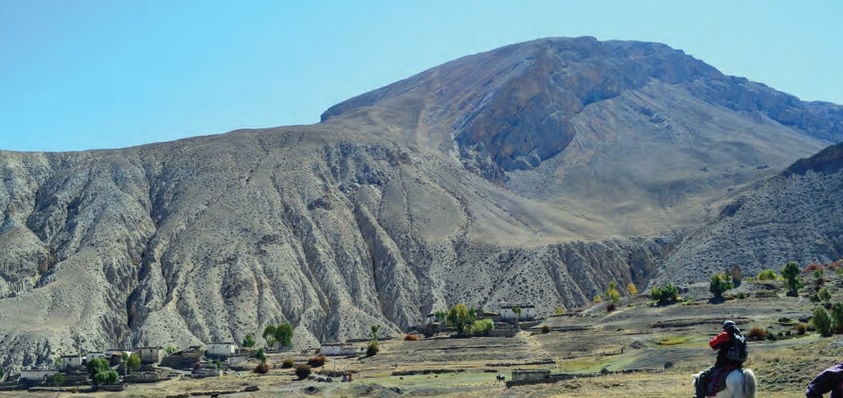

In the high mountains of Mustang, a village that once sustained dozens of farming families now stands nearly empty. Dhye village, located in Loghekar Damodarkund Rural Municipality, was gradually abandoned over the past two decades after the spring that sustained it began to dry up.
Water is the first language of any civilisation, understood before words and measured long before money. When it disappears, people follow, leaving behind landscapes that still remember what they once held.
High in Mustang’s trans-Himalayan landscape, Dhye village sits at nearly 4,000 meters above sea level. Two decades ago, the settlement supported around 30 to 35 households who relied on subsistence farming and livestock herding. In this rain-shadow region, monsoon clouds rarely arrive. Agriculture depended less on rainfall and more on glacial melt and underground springs replenished by winter snowfall.
For generations, a single spring supplied drinking water and irrigated the village’s terraced fields of barley, buckwheat and potatoes. The rhythm of daily life — planting crops, watering animals and maintaining fields — followed the flow of that fragile source.
The Slow Vanishing of Dhye’s Water
By the early 2000s, villagers began noticing changes. The spring that had sustained them for generations was weakening. Winter snowfall, which historically replenished groundwater and mountain springs, became less reliable.
Across the Himalayan region, rising temperatures have begun to disrupt long-established water cycles. Glaciers in Nepal’s section of the Hindu Kush Himalayas melted about 65 percent faster between 2011 and 2020 compared to the previous decade. Scientists warn that the region could lose up to 80 per cent of its glacial ice by the end of the century if global emissions continue at current levels.
For Dhye, these changes were felt not in distant projections but in everyday survival.
Over the next two decades, the village’s water source steadily declined. Irrigation channels dried up, and wells stopped filling. Streams that once carried snowmelt turned into dry channels. Residents began walking hours each day to collect water, a task that often fell on women and elderly residents.
Farming grew increasingly difficult. Crop yields dropped, livestock numbers declined and more than half of the cultivable land in Dhye and nearby settlements was eventually lost due to severe water scarcity.
Migration and Abandonment
By the early 2010s, the situation had become unsustainable. Without a stable water supply, both agriculture and daily life became nearly impossible. Seasonal migration, once a temporary strategy to supplement household income, gradually turned into permanent relocation.
Most families eventually moved to lower areas, particularly the settlement of Thangchung about 300 meters below their ancestral village, where water access is more stable and infrastructure such as roads and schools exists. Others migrated further south, relying partly on remittances to sustain their households.
Today, Dhye stands largely silent. Some houses remain intact while others slowly crumble under mountain winds. Terraced fields lie uncultivated, and faded prayer flags hang over abandoned courtyards. Former residents occasionally return during festivals or to check on their property, but the rhythms of daily village life are gone.
A Warning from the Mountains
Dhye is widely considered one of Nepal’s earliest and clearest examples of climate-induced internal displacement. The disappearance of the water source highlights a growing but often overlooked reality in Nepal’s mountain regions: climate-driven water scarcity is already forcing communities to relocate.
In regions like Mustang, where annual rainfall can fall below 200 millimetres, even small shifts in snowfall or temperature can have major consequences for water security. Researchers increasingly describe such movements as internal climate displacement — when environmental change gradually forces communities to relocate within their own country.
Nepal has begun placing greater policy focus on climate adaptation. National Adaptation Plans emphasise water security, climate-resilient livelihoods and improved infrastructure in vulnerable mountain districts. Mustang itself has gained attention in recent years due to growing desertification, erratic snowfall and flash floods.
Yet abandoned settlements like Dhye reveal how slowly adaptation often arrives in remote mountain communities.
Water scarcity is frequently discussed as a future risk. Dhye shows that, for some communities, the crisis is already present.
Globally, climate-induced migration is expected to increase in the coming decades. While low-lying islands face rising seas and coastal regions prepare for stronger storms, Nepal’s high mountains face a different challenge — not too much water, but too little.
Dhye reminds us that climate migration is often gradual and largely invisible. It does not always happen through sudden disaster but through quiet changes that slowly make everyday life impossible.
Civilisations may be built on ambition and labour. But first, they are built on water.
Sudipa Mahato is a junior editor at Nepal Connect.