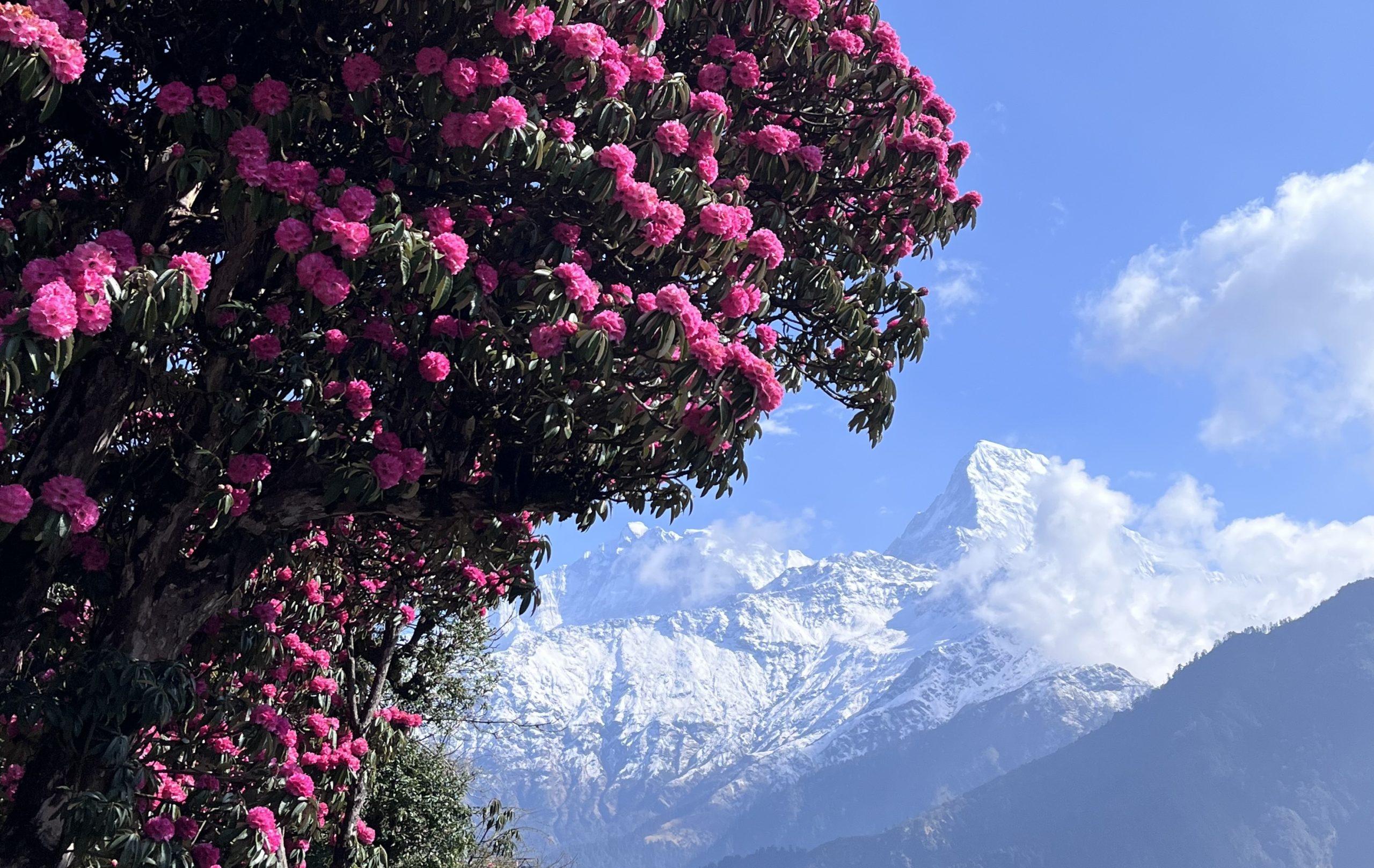

Every spring, the country becomes a canvas as a variety of flowers bloom across the hills and mountains. Among them is the rhododendron, also known as Laligurans, the national flower of Nepal. This flower holds a special place in the hearts of Nepali people, as it was declared the national flower by the late King Mahendra Bir Bikram Shah in 1962.
Building on this national pride, rhododendrons belong to a vast genus with over a thousand species worldwide, most of which are concentrated in the Himalayan and East Asian regions. Nepal hosts more than 30 species: some common, some rare, and some found only within narrow ecological bands. These flowers bloom especially during April and May, displaying different forms and colours as they adapt to varying climates and altitudes across the Himalayas.
Beyond their biological diversity, rhododendrons also carry deep cultural resonance. They appear on emblems, postal stamps, and coins and feature in songs and poetry. For centuries, Nepali love songs have likened a beloved’s blush to hills covered in red gurans. The legendary Nepali singer Narayan Gopal, revered as Swar Samrat (Emperor of the Voice), immortalised the flower in his song Ma Ta Laligurans Bhayechhu. Every spring, the Helambu region celebrates a Lali Gurans festival to honour the bloom. In religious settings, rhododendron blossoms are often offered at hill temples, while some married women wear the flowers or petals in their hair as adornment.
Many folktales around the world speak of rhododendron forests as enchanted realms, though the myths vary by region. One popular Nepali folktale tells of a love story between the sun and the moon. When they decided to marry, jealous gods sent storms to stop the wedding. The rhododendron flower protected them and helped unite them, leading people to believe the flower was blessed by both celestial beings.
Traditionally, the petals are brewed into syrup or liquor, and the blossoms produce fragrant spring honey. Honey from some species, such as the yellow azalea, contains greyanotoxins that can be highly intoxicating. These are mainly harvested in central and western Nepal.
People also pickle the blossoms or steep them in tea, and some Himalayan communities use herbal infusions of gurans for their believed health benefits. Locals gather rhododendron wood for fuel and construction, and historical accounts note entire forests being cut for firewood. For example, lodges in the Annapurna region once used split rhododendron trunks for cooking stoves until fuel-efficient alternatives were introduced. Ethnomedicinally, its juice is used as a folk remedy for dysentery and as a hair tonic.
A Flower Across Altitudes
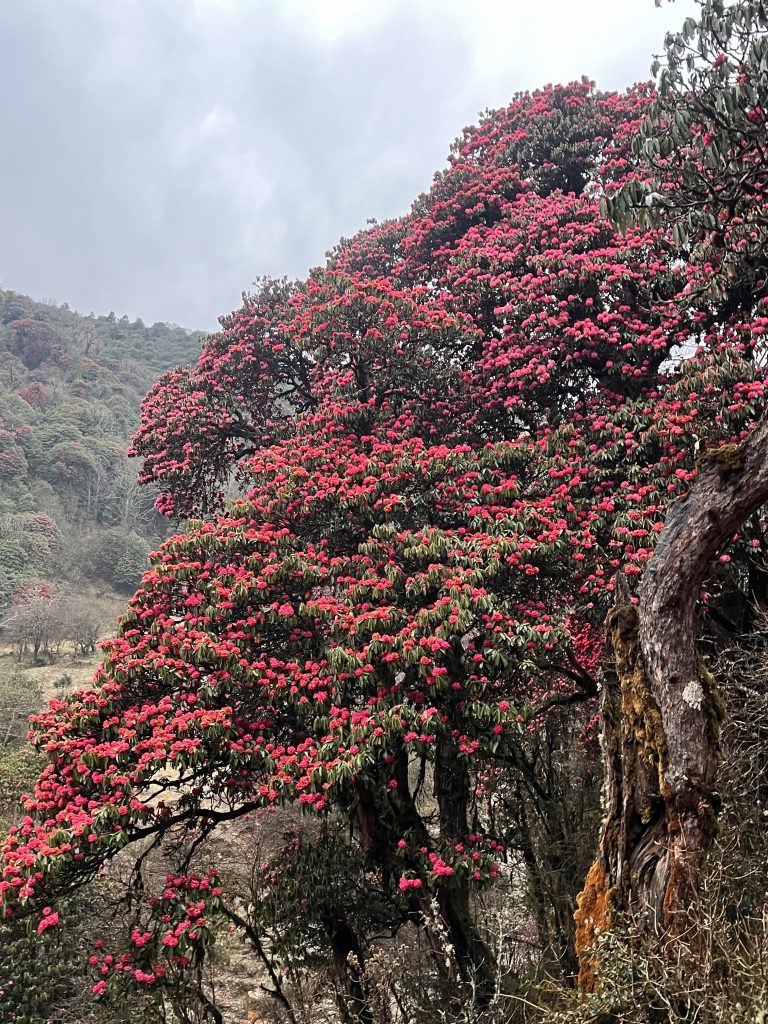
These flowers bloom across different places and elevations, with their colours gradually turning paler at higher altitudes. The most famous species is Rhododendron arboreum (Lali Gurans), a tree that can grow up to 10–20 metres tall and bears clusters of scarlet-red bell-shaped flowers. It blooms in the mid-hills at elevations between 1,400 and 2,800 metres.
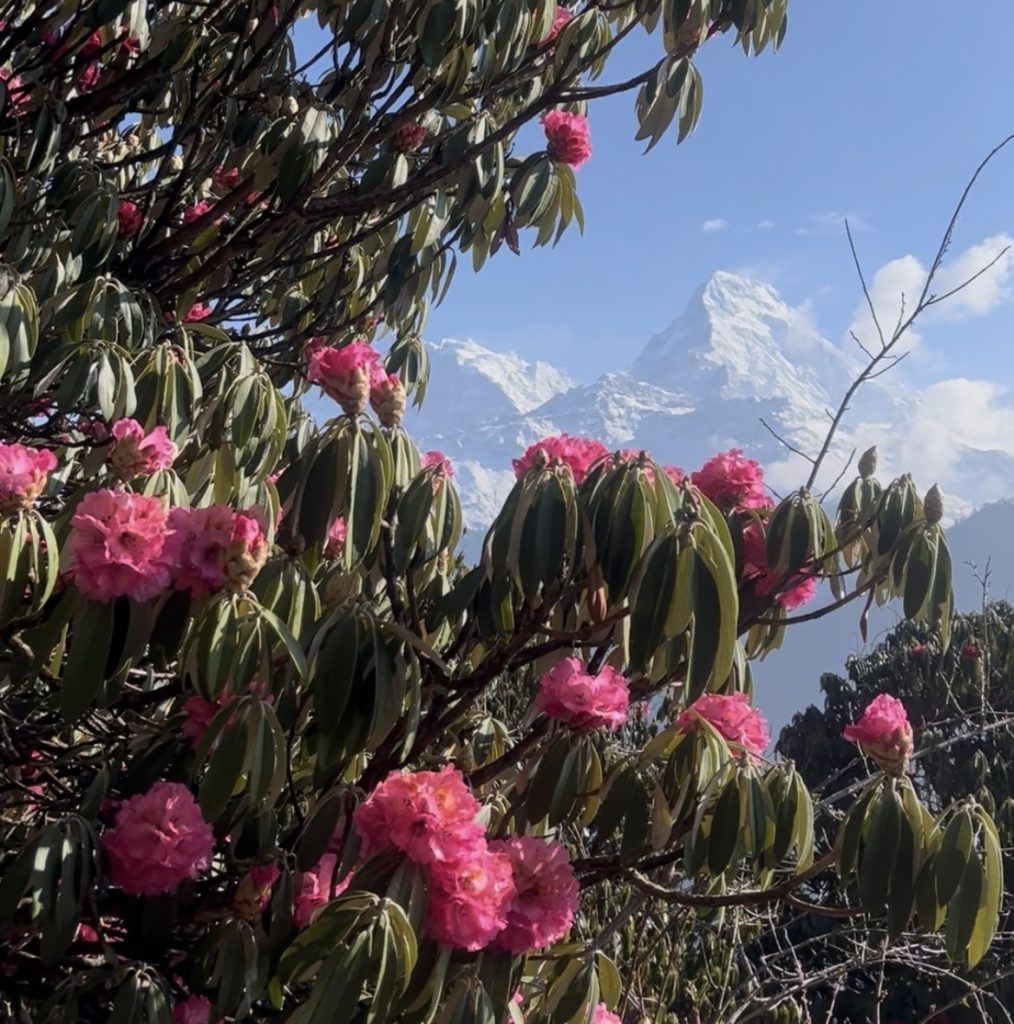
At higher elevations, around 2,000 to 3,000 metres, pink-flowered species such as R. barbatum and R. campbelliae appear. Above 3,000 metres, forests transition into white or pale rhododendrons like R. campanulatum and R. setosum. Their blooming follows a vertical sequence: red Lali Gurans begin flowering in March in the lower hills, mixed pink and white varieties bloom around 2,500 metres in April, and high-altitude white rhododendrons appear by May.
Many tourists visit places such as Poon Hill and Ghorepani just to catch a glimpse of these blooms. Other places, such as Langtang National Park, the Annapurna region, and the Everest region, are also among the best places to see rhododendrons.
A Bloom Under Threat
While rhododendrons remain abundant, many species face increasing pressure. Globally, around 25 per cent of rhododendron species are threatened with extinction due to habitat loss. In Nepal, uncontrolled deforestation for timber and farmland, along with road construction, has fragmented rhododendron forests. Overharvesting for fuel, timber, commercial flower collection, and livestock grazing has further degraded these habitats.
Climate change presents an additional threat. Warmer temperatures may cause flowers to bloom earlier and allow lower-altitude species to move upward, potentially outcompeting native high-altitude varieties.
Several studies and conservation agencies in Nepal have highlighted these concerns. One report warns that rhododendron forests in the Tinjure-Milke-Jaljale region of eastern Nepal are under threat from illegal logging and encroachment. The Nepalese Rhododendron Conservation Action Plan (2018–2023) was drafted to address such issues through habitat protection and community forestry initiatives.
Protected areas such as Makalu-Barun National Park, Annapurna Conservation Area, and Kanchenjunga Conservation Area play a key role in preserving large rhododendron habitats. The National Trust for Nature Conservation has also introduced fuel-efficient stoves and forest management programmes to reduce woodcutting. International conservation groups have supported land purchases to reconnect fragmented habitats. Still, many high-altitude species remain poorly surveyed and understudied.
In the end, Nepal’s rhododendrons are best understood not simply as a list of species but as a vertical journey through altitude and climate. Each elevation carries its own version of the flower: tall and vibrant in the lower hills, varied and colourful in the middle ranges, and small yet resilient near the snowline. To walk through Nepal in spring is to move through these layers one by one, watching the same genus continuously reshape itself in quiet adaptation to the mountains.