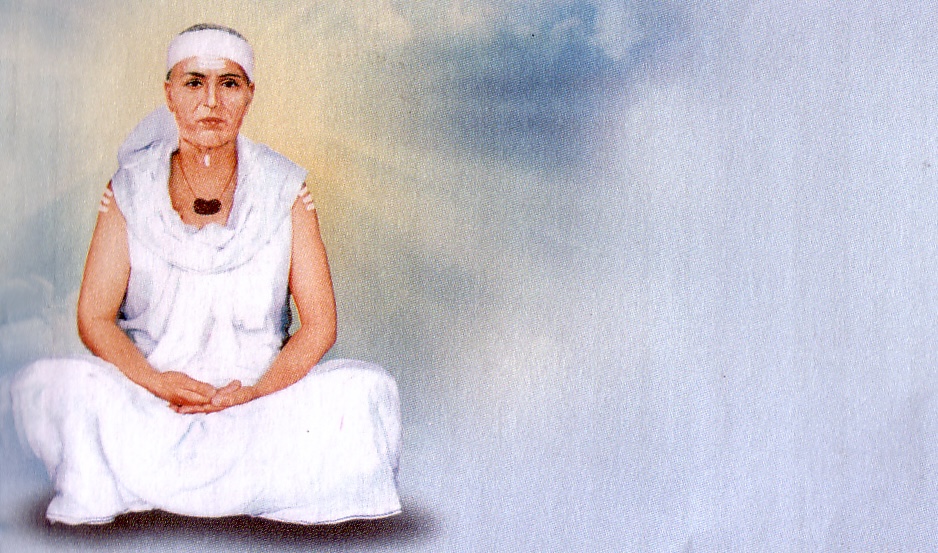

On a July morning in 1941, Yogamaya Neupane walked into the Arun River with 67 disciples and never walked out. It was an act of political theatre so extreme that the state buried it for sixty years — and very nearly succeeded.
There is no grave to visit. The Arun River, which runs cold and fast through the gorges of eastern Nepal, gave back nothing; not a body, not a garment, not a sandal. When Yogamaya Neupane led her disciples into its current on 14 July 1941, she knew this. She had planned for it. The authorities would be denied a burial to suppress, a relic to confiscate, and a martyr’s tomb to quietly dismantle.
But she could not foresee how completely the state would erase her from history, from textbooks, and from the national memory. For sixty years, she barely existed in the public record. Her book was illegal. Her name was mud. And the cause she gave her life to was attributed to the men who had ignored her demands.
She was Nepal’s most radical political act of the twentieth century. She was also, for most of that century, unknown.
From Disgrace to Holiness
She was born Mayadevi Neupane in the village of Majhuwabeshi in Bhojpur, eastern Nepal, into a Brahmin family whose respectability would come to feel like a cage to her. She was married at seven. What followed is disputed, as so much of her life would be.
One account holds that her husband died when she was ten, leaving her a child widow and, in the eyes of her in-laws, a burden and a bad omen. She was ostracised and eventually fled. Another account suggests the marriage lasted somewhat longer before she left, and that her husband later remarried after she eloped, making her an escapee rather than a widow. The distinction mattered enormously in the social calculus of the time.
What followed was a life of movement and reinvention. She first fled to her mother’s home, then eloped to Assam with a Brahmin man. That husband died. She married again; from this third marriage, a daughter was born. By the early 1900s, she renounced it all.
She returned to Bhojpur not as a disgraced woman but as something far harder to dismiss: a holy one.
The Ascetic Who Read the Caste System As Sin
Renamed Bidushi Yogmaya, she fasted, meditated in caves and gathered disciples. Her austerity was genuine, but it was not passive. Her spiritual life had a social agenda.
She wrote devotional songs, called baani, later collected as Sarvartha Yogbani. Cast in the register of religious verse, they were in fact a sustained indictment of caste hierarchy, the forced seclusion of women, polygamy, and the widow’s life, which she understood from the inside. That she used the language of Hindu morality rather than the language of rights was not a compromise. It was a strategy. She was speaking to people who would otherwise not have listened.
She welcomed low-caste followers into her circle. In a society where such boundaries were not merely social conventions but legally enforced, this was no minor eccentricity. It was provocation. And it announced, from the outset, the nature of what she was building.
Nepal’s First Women’s Organisation
Around 1918, Yogamaya founded Nari Samiti, the Women’s Society, an organisation without a clear precedent in Nepali history. It wrote letters. It lobbied. It directed its petitions to the apex of power: the Rana oligarchy, which had ruled Nepal since 1846 as a closed dynasty of prime ministers, keeping the monarchy ceremonial and the population subordinate.
Her demands were framed as moral imperatives of dharma-rajya, meaning just and righteous rule, yet their content was concrete: an end to corruption, the protection of women from abuse, and the abolition of Sati, the practice in which widows were burned alive on their husbands’ funeral pyres.
The letters reached Prime Minister Chandra Shumsher. In 1920, he outlawed Sati in Nepal. The official proclamation credited the state. Yogamaya’s name did not appear. It would be the first of several appropriations.
A Confrontation That the Records Refused to Keep
By the mid-1920s, her following was substantial, and she had reportedly begun confronting Rana officials directly. These are the kind of encounters that oral tradition preserves, and bureaucracy does not. In 1936, she went to Kathmandu, demanding of the ruling prime ministerial line what she described as “Truth! Dharma! Alms!”, formulations her followers understood as calls for accountable government and expanded rights for women.
Promises, it seems, were made. Promises were broken. This would prove to be the ultimate cycle.
In 1938, she assembled 204 followers and led them towards a mass immolation. Local authorities intervened and arrested her before any deaths occurred. She was held briefly and released in 1939. The episode, extraordinary in scale and ambition, left no mark on the official record.
Into the Arun
On the morning of 14 July 1941, at the height of the monsoon, when the Arun runs at its most violent, Yogamaya Neupane led 67 disciples to the riverbank.
Eyewitnesses would later describe what they heard as the group waded in: ‘May the unjust Rana government be destroyed! May dharma be established!’ Then the river took them. None returned. No bodies were recovered. Nepal’s largest recorded act of collective self-sacrifice had been witnessed by villagers whose testimony would not be welcomed by any official for decades.
Her followers did not call it suicide. They called it Jal-Samadhi, a sacred dissolution into water, a death framed not as defeat but as the final, unanswerable demand. The logic was ancient, but the politics were not: if the state would not listen to their lives, perhaps it would feel the weight of their deaths.
The Rana regime did not feel it. Or rather, it felt it enough to panic.
Sixty Years of Suppression
The censors acted with the efficiency that autocracies reserve for inconvenient truths. Discussion of the Jal-Samadhi was forbidden. Sarvartha Yogbani was banned and would remain so until the year 2000. The oral histories circulated in private, in hushed tones, among the surviving disciples and their descendants in the Arun Valley. Officially, none of it had happened.
When the Rana regime fell in 1951 and Nepal entered a new political era, the erasure was not undone. It was simply inherited. Successive governments continued to credit Chandra Shumsher with abolishing Sati. Yogamaya’s role in pressuring that decision was not restored to the record. The widows she had fought for were taught nothing about her.
Conservative elites had their own reasons for keeping her buried. They had long characterised her as wayward, licentious, and mentally unstable — the standard vocabulary deployed against women who made powerful men uncomfortable. She had challenged gender norms from within the very idiom of religious authority; the response was to impugn the woman rather than engage with the argument.
The Anthropologist and the Survivors
Recovery came slowly, and it began from outside. In the 1980s, the American anthropologist Barbara Aziz, working in the Arun Valley, found something unexpected: a community of Yogamaya’s surviving disciples, elderly women who had not drowned on that July morning and who had spent forty years keeping the memory alive in the only way left to them: by talking.
Aziz documented what she heard. It marked the beginning of a longer reclamation. Nepali scholars, including Hutt, Ghimire, and Timsina, among others, followed up with written reassessments. Activists in Kathmandu and the east began invoking her name. In 2017, the novelist Neelam Karki Niharika won Nepal’s most prestigious literary prize, the Madan Puraskar, for Yogmaya, a biographical novel based on her life.
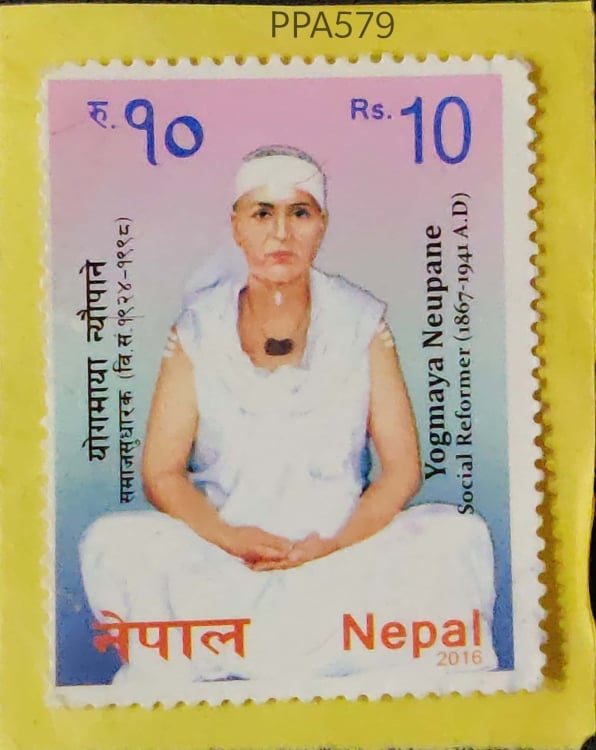
The state moved, as states do, belatedly and in the language of monuments. A statue was unveiled in Bhojpur on International Women’s Day in 2011. A commemorative postage stamp followed in 2016. An Ayurveda university has since been named in her honour.
What the Textbooks Still Say
None of this has solved the textbook’s problem. Yogamaya appears in Nepali school curricula only in specialist history or literature courses; most students encounter her, if at all, as a footnote rather than a chapter. The abolition of Sati is still widely taught as an act of Rana enlightenment, with Chandra Shumsher cast as the reformer. Feminist activists hold ‘Yogmaya marches’, particularly in the east, where the Arun still runs and oral memory runs deepest, but she has not entered the kind of national consciousness that makes a figure unignorable.
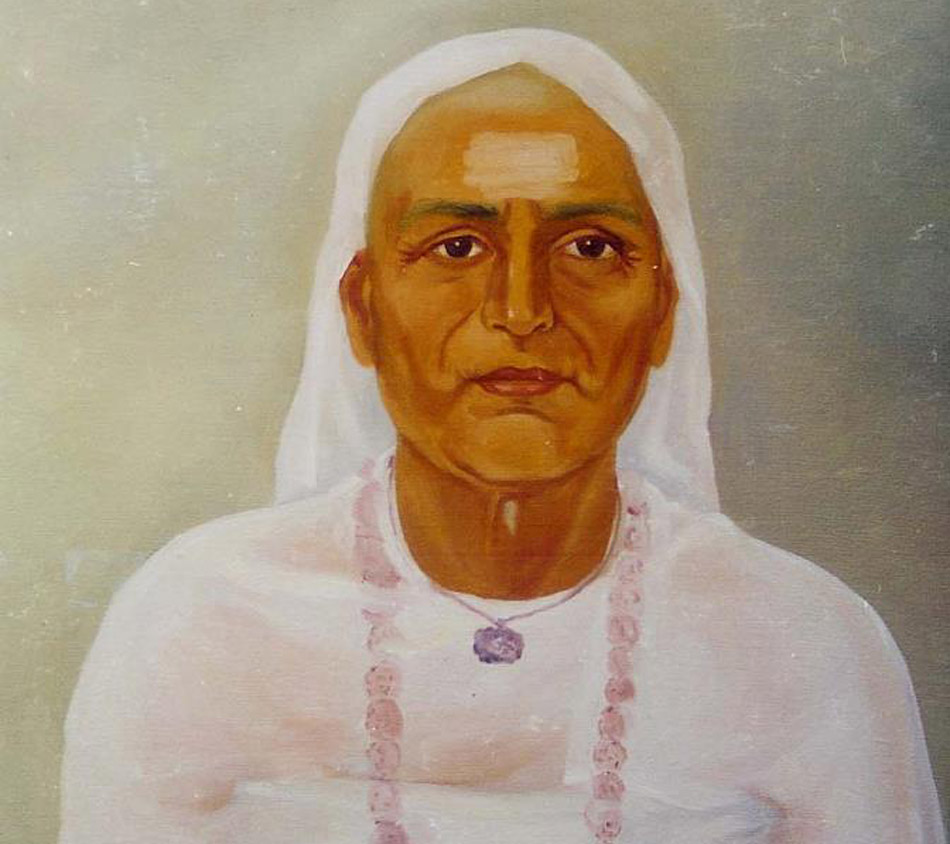
The label most readily attached to her now is “Nepal’s first feminist” or “first feminist revolutionary.” It is not wrong, but it needs careful handling. Yogamaya did not think in those terms, did not use that language, and would likely have found the framework unfamiliar. She was a Hindu ascetic who read the structures of oppression as violations of dharma and demanded justice in the name of the divine. The political content of her demands was entirely modern; the idiom was ancient. That combination is precisely what made her so difficult for her contemporaries to dismiss and so easy for posterity to mislabel.
What she actually was is harder to summarise and more interesting: a woman who had been failed by every institution available to her, including marriage, family, caste, religion, and the state, who built something new from the wreckage, drew hundreds to it, and ultimately chose a death so public and deliberate that it could not be called anything other than a demand. She asked Nepal to feel ashamed of itself.
For sixty years, Nepal managed not to. The question now is whether it has truly started.