




A Teacher’s Journey Through Open Education in Nepal
For most of my career, I have taught English in places that the mainstream education system tends to overlook. I have stood not only in classrooms in the Kathmandu Valley but also in remote districts of Nepal, at levels ranging from early childhood to secondary school. Over time, I moved from being a teacher to a vice principal to a headteacher. I was eventually appointed a permanent second-class secondary English teacher, a position I hold to this day. But position and qualification are not the same as knowledge, and I knew, even after completing my M.Ed. from Tribhuvan University, that I wanted to go further.
The problem was simple: I could not leave.
A permanent government appointment is not something someone in Nepal would set aside to attend classes. I began looking for an online programme and found Nepal Open University (NOU). I filled out the form, sat in the entrance examination, and was selected for the MPhil in English from the Education Faculty. The following three semesters of research courses, online lectures, conference presentations, and proposal writing have fundamentally changed how I understand both scholarship and teaching.
What Open Education Promised
The instructors in NOU are highly qualified. The examination system is conducted online with two devices, under timed conditions, with answer sheets submitted in PDF format. The courses are substantive, connecting English language education to wider questions of global development, South Asian literary culture, translation theory, and research methodology.
The flexibility that open education offers is often spoken of in logistical terms: “you can study from home, you can attend recorded sessions when live ones conflict with work, and so on.” These things are real and valuable. But what struck me more was the program’s intellectual seriousness. We were not given easier tasks because we were remote. We were expected to produce research papers, present them at academic conferences, and eventually write a full research proposal and a collaborative journal article.
I came into the MPhil knowing how to teach English. I did not know how to conduct research on it. The two are not the same, and the distance between them is larger than I had expected.
The first course I encountered was ‘English Studies for the Twenty-First Century’, taught by Dr Komal Phuyal. It covered the history and global spread of English, digitalisation, and the development of literary and linguistic theory. But more than the content, it was Dr Phuyal’s teaching method that changed me. He was precise where precision mattered: what belongs in an introduction, what a literature review actually does, and how to identify a research gap. He taught us to read actively and to prepare notes, quotes, and reflections before we ever began writing. He held us to those habits every session.
The second course that semester, ‘E-Research Philosophy and Strategies’, was taught by Dr Shiva Rijal. Where Dr Phuyal grounded us in the practice of literary research, Dr Rijal opened up the digital landscape in which contemporary scholarship lives. He introduced us to the development of eLearning, ICT in education, e-research methodologies, and collaborative research platforms. He was equally clear about the risks that come with that landscape, including plagiarism, the misuse of digital tools, and the uncritical reliance on unverified sources. Together, the two courses gave me the foundation I had been missing for thinking like a researcher and working like one.
Alongside the instructors, Programme Coordinator Laxman K.C. proved to be a constant and reliable presence. In an online learning programme, where confusion about deadlines, platforms, and procedures can quickly derail progress, he was always available and always responsive. Any problem put to him was solved without delay.
My First Conference
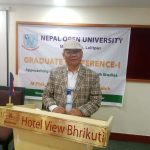
Dr Phuyal organised a graduate conference at the end of the first semester. The keynote address was delivered by Prof. Dr Ammar Raj Joshi, who would later become one of my instructors in the second semester. The conference asked us to present original research, and I submitted a paper on the psychoanalytic dimensions of William Faulkner’s “A Rose for Emily.”
I had written research papers before in the technical sense, as I had submitted assignments, completed examinations, and produced coursework. But I had never stood before an academic audience offering an original analysis. It was Dr Phuyal who made that experience possible, pushing us to engage not just with the text but with the scholarship around it, to locate our arguments within a broader intellectual conversation. Presenting that paper, receiving responses, and learning to comment on others’ work in turn made me bold in a way that classroom teaching alone had not.
Translation, Cities, and the Second Semester
The second semester brought three new courses and two new instructors.
Prof. Dr. Ammar Raj Joshi taught ‘Translation Studies’ with a lively, engaged style that brought the subject’s theoretical dimensions to life. I learned the history of translation as a discipline, the theories that underpin it, and the cultural politics embedded in the act of rendering one language into another. More importantly, I practised it by translating Nepali poems and stories, working through the friction between languages, and discovering in the process that translation is not just a technical skill but an interpretive one. Prof. Joshi’s teaching gave me practical confidence in that work.
‘South Asian Cities in Literature’ was taught again by Dr Komal Phuyal. In this course, I encountered frameworks for reading cities as physical, political, psychological, and spiritual spaces, while engaging with literary texts from across South Asia that portrayed urban life in all its complexity. Dr Phuyal brought in an extended virtual lecture series featuring scholars from universities across the region, widening our sense of what South Asian literary scholarship looks like in practice.
The Practice of Research: Independent Studies
The third semester’s ‘Independent Studies’ course, taught by Dr Komal Phuyal again, has been the most demanding and the most rewarding part of the programme. It has no fixed syllabus. Instead, it is structured around learning by doing, with a collaborative research paper co-authored with the instructor, an independent project, and a research proposal.
In the collaborative paper, Dr Phuyal gave us primary and secondary sources to read, asked us to prepare notes and reflections, and then guided us through the full architecture of a research article: introduction, methodology, literature review, textual analysis, and conclusion. The finished paper was published in a journal. The experience of taking a piece of writing through every stage to publication, under the close supervision of someone who has done it many times, was unlike anything else in my academic life.
For my independent proposal, I have chosen to write on Samrat Upadhyay’s ‘Arresting God in Kathmandu’ and ‘The Royal Ghost’, two story collections that portray Kathmandu’s urban anxieties, class aspirations, and consumerist culture. Dr. Phuyal’s guidance on how to frame the proposal, build a working bibliography, and determine where AI can legitimately assist the process and where it cannot has been invaluable. He was explicit and principled on this last point: AI may be used to locate sources and generate a reading bibliography, but the analysis, the argument, and the writing must be the researcher’s own. At a time when these boundaries are widely blurred, his clarity was bracing.
What strikes me most about Dr Phuyal, taken across the three semesters in which he has taught me, is his consistency. He continued teaching through what I later learned was a period of serious physical difficulties, including an appendix operation and a broken leg, without interruption and without any reduction in the quality of his engagement. That kind of dedication is not common. It communicates something beyond professionalism; it suggests a genuine belief in the work and in the people doing it.
Gaps That Remain
Open education in Nepal has a structural problem that no amount of good instruction can compensate for: there is no library.
Research requires access to authenticated secondary sources. Without an institutional repository or a virtual library that enrolled scholars can access freely, we are dependent on whatever is openly available online, which is uneven in quality and often incomplete. The credibility of our research is only as strong as the sources we can access, and right now that access is insufficient. A scholar at a residential university takes library access for granted. A scholar at Nepal Open University must work around its absence every day.
There are smaller issues, too. The digital infrastructure was well-organised in the first semester, but became less consistent as we progressed. Course content and reading materials were sometimes not available when the semester began. These are administrative problems, not academic ones, but they matter. Open education only works when its digital scaffolding is maintained as carefully as its curriculum.
The Bigger Picture
With my MPhil classes, I am not returning to my classrooms unchanged. Understanding how English developed as a global language, how literary texts encode social anxieties, and how research is constructed and evaluated alters how I read texts with my students, the questions I ask, and the standards I hold myself to. The quality of teaching is not only a function of qualifications; it is a function of how seriously a teacher continues to learn. The instructors I have encountered at Nepal Open University, Dr Phuyal, Dr Rijal, Prof. Dr Joshi, and Bishnu Prasad Pokharel, have modelled that seriousness in different ways, each of them. Coordinator Laxman KC has ensured that the learning conditions remained intact.
Nepal Open University has an extraordinary opportunity. It can reach teachers, government employees, and rural scholars who, like me, are unable to attend residential programs but are no less serious in their intellectual ambitions. With an authenticated virtual library, stronger module preparation, and sustained investment in digital infrastructure, it could become not just a flexible alternative but a leading institution in its own right.