
Why are women now allowed to dance female roles?
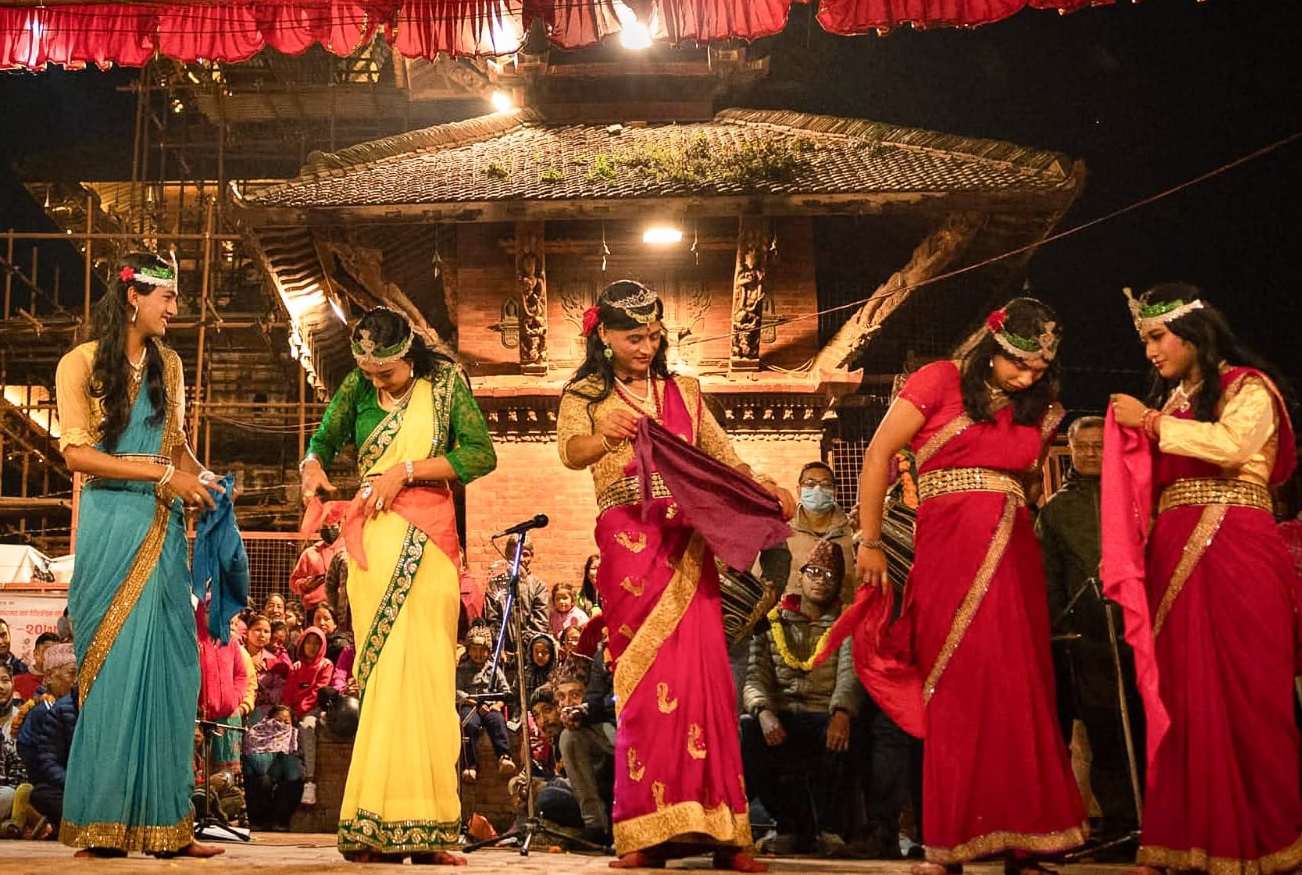
The audience admiring the gorgeous women dancers at the traditional Newari festival (Jatra) of Kartik Naach this fall may not realise that these beauties are men. In many such dances, female roles have traditionally been performed by men. However, things are changing.
Most jatras stem from traditional practices intended to keep the gods happy. Kartik Naach is a dance festival founded by King Siddhi Narsingh Malla in the mid-17th century to celebrate Lord Vishnu’s Narsingha Avatar’s victory over the demon king Hiranyakashipu. It was first performed to avert a bad omen in the Malla Kingdom.
Social Restrictions on Women
Kartik Naach is performed over 27 days, depicting 17 tales of Lord Vishnu. Tradition has never made space for women, even though the narratives include several female characters.
Kiran Chitrakar, chairperson of the Kartik Naach Preservation Committee, explains that from the very beginning, all roles, including female characters, were performed by men. This was due to social restrictions on women at the time. Kartik Naach is a tantric dance, and traditional beliefs surrounding menstruation contributed to women’s exclusion.
“That is why women are still not involved. At least, that is how we have thought about it,” he says. Many masked dances also follow the same norms. “Maybe in the future, women will also start dancing here”.
Nischal Shakya has been performing as an Apsara1 since 2016 and continues to do so today. It has been over a decade since he began dancing in female roles.
“It is difficult to dance as a woman after wearing heavy makeup and costumes,” he says. “Even the audience often thinks we are women and gets confused, believing that it is women performing.”
Yet in other parts of the Kathmandu Valley, women began to participate in similar traditional performances.
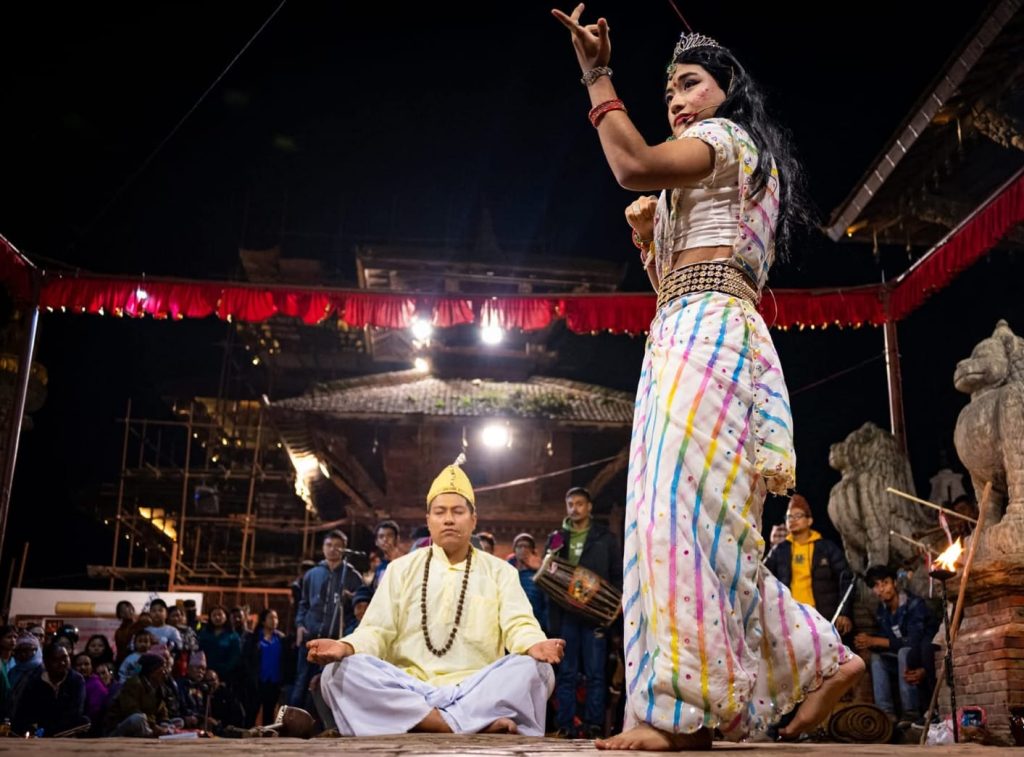
Legend has it that the Hindu god Vishnu disguised himself as the seductress Mohini to lead the demon Bhasmasura to his own destruction. During Gai Jatra in Bhaktapur, this dance, also known as Mohini Naach, is now performed by women.
New Social Realities
Prajita Shrestha is only the fourth woman to dance the role of Mohini. As a child, she saw men perform the role, found the dance mesmerising, and was inspired to go on stage and dance herself, probably unaware of the traditional boundaries.
“The transition from male impersonators to female dancers was stimulated by the legendary Shree Gopal Prajapati,” says Shrestha. “Hewas among the first to believe that women should also be allowed to dance.”
Through his interference, women were introduced to the Astamatrika dance2, a performance centred on eight goddesses that had previously been performed by men. This eventually opened doors for women in other traditional dances as well.
Bibek Tandukar, founder of the group ‘The Newars’, notes that women’s involvement in jatras has changed significantly over time. “Earlier, women were expected to remain indoors while men occupied the public spaces during festivals,” he says. “Now, women are actively involved in the field. At this stage, character and gender should not define participation. Our main goal is to preserve our culture. When it comes to cultural preservation, women should be able to perform male roles, and men should also be able to perform female roles.”
While the inclusion of women was once not accepted, some communities are adapting to new social realities. This could encourage others to also push for equal participation. It is only when everyone comes together that the culture can thrive.
Notes
- Apsara: celestial dancer or nymph. ↩︎
- The Astamatrika dance, known locally as Gá: Pyakhan or Gaan:Pyakha, is a 350-year-old sacred mask dance from Patan, Nepal, performed by the Newar community (Shakyas and Bajracharyas) during the Dashain festival. ↩︎
About author
Pratikshya Bhatta is a junior editor with Nepal Connect.