
Support independent and reliable information and inspiration
about the development of Nepal at €10, €20, €30 per month

Advertisement

WORK IN PROGRESS

  • Login
  • Register
SUBSCRIBE
NepalConnect
  • DIGEST
    • CURRENT AFFAIRS
    • DEVELOPMENT
    • DISCOVERY & TRAVEL
    • IN-DEPTH
  • FEATURES
  • LIBRARY
  • TRAVEL DESK
  • DIRECTORY
No Result
View All Result
  • DEVELOPMENT
  • CURRENT AFFAIRS
  • TRAVEL & DISCOVER
  • IN-DEPTH
NepalConnect
  • DIGEST
    • CURRENT AFFAIRS
    • DEVELOPMENT
    • DISCOVERY & TRAVEL
    • IN-DEPTH
  • FEATURES
  • LIBRARY
  • TRAVEL DESK
  • DIRECTORY
No Result
View All Result
NepalConnect
No Result
View All Result
Home Digest IN-DEPTH Scientific studies
Something Oily Beneath Dailekh 

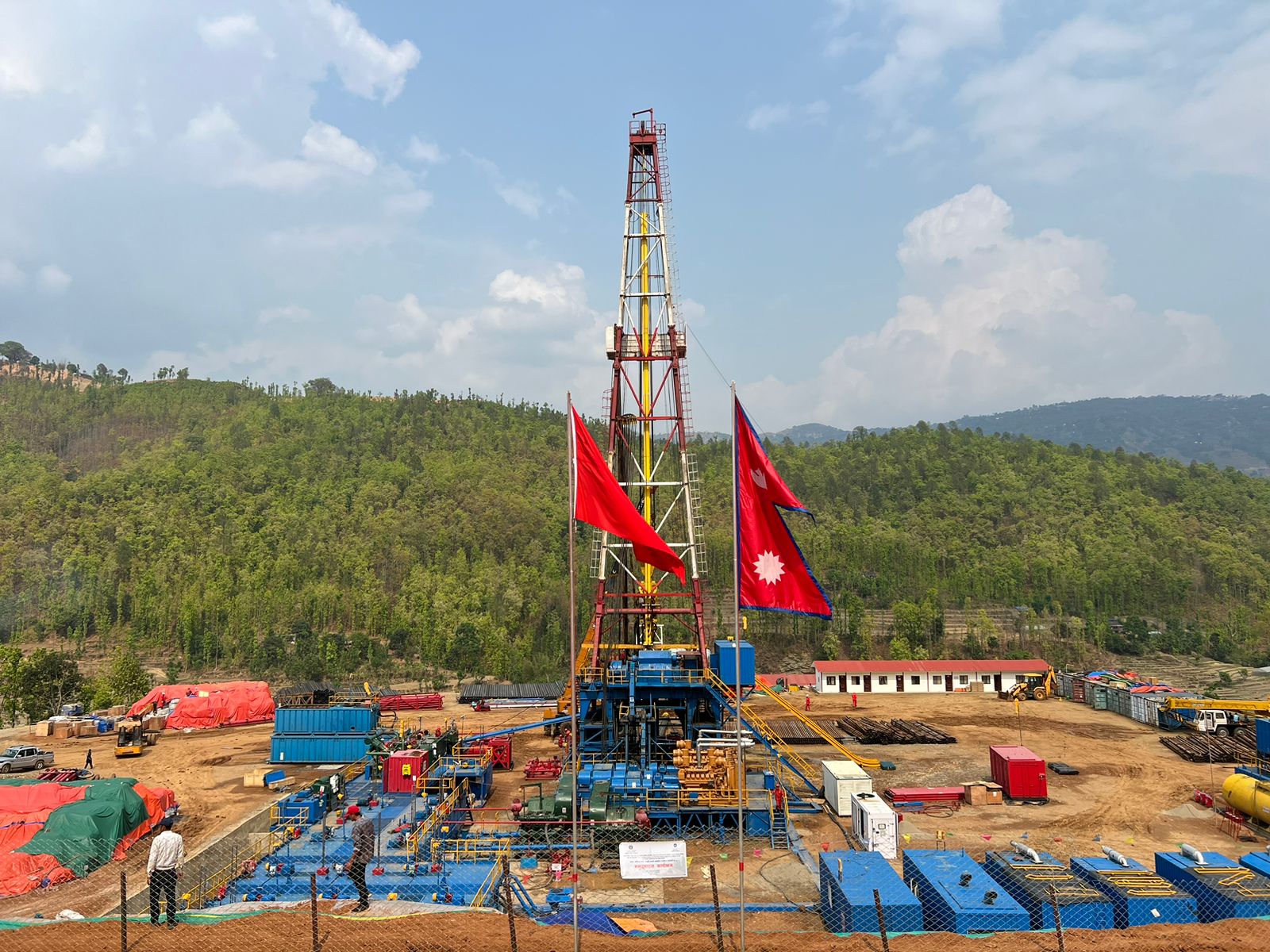
The petroleum exploration site at Dailekh. Photo: petroleumnepal.gov.np

Something Oily Beneath Dailekh 

Sudipa Mahatoby Sudipa Mahato
January 8, 2026
in Scientific studies
0

For decades, nearly all petroleum products consumed in the country have been imported, leaving the economy exposed to price fluctuations, supply disruptions, and political pressure. 

In 2025, however, a drilling site in the mid-hills of Dailekh emerged as a project of national significance, reopening questions Nepal has asked, and abandoned, many times before. 

Before petroleum reshaped the modern world, societies relied on wood, coal, and animal fats for energy. The refinement of crude oil in the nineteenth century transformed economies, enabling industrial expansion and giving rise to powerful oil-producing states and multinational corporations. Over time, energy security became central to governance, diplomacy, and global politics. 

Countries without oil were forced to adapt. Some invested heavily in alternatives; others depended on trade and diplomatic relationships. Nepal, constrained by geography and limited industrial capacity, followed the latter path. While hydropower became its long-term energy focus, petroleum remained essential for transportation, industry, and daily life. 

Nepal’s interest in petroleum exploration is not new. For generations, communities in western Nepal have been aware of natural gas seepage and oil-like substances. Formal exploration began in the late 1970s with government-led geological surveys supported by international agencies. Aeromagnetic and seismic studies were conducted across large parts of the country, particularly in the Terai, driven by hopes that sedimentary basins similar to those in neighbouring regions might exist beneath Nepal’s surface. 

Over the following decades, several foreign companies were granted exploration licences. Some carried out limited studies, others failed to meet contractual commitments, and none discovered commercially viable petroleum reserves. By the mid-2010s, most licences had been cancelled, and petroleum exploration became a recurring headline that rarely translated into results. 

The 2015 blockade forced a reassessment of Nepal’s energy priorities. The fuel crisis revealed how quickly external disruptions could turn dependence into a national vulnerability, pushing indigenous energy resources—long dismissed as impractical or secondary—into the realm of strategic necessity. 

It was in this context that older prospects were revisited with renewed seriousness. Petroleum exploration in Dailekh, which dates to 1979 and is grounded in long-observed natural gas seepage, gained fresh attention. The consistency of these signs and the area’s geological features justified deeper investigation, eventually leading to a government-to-government agreement between Nepal and China in 2019 to carry out systematic petroleum exploration in the district. 

The project, estimated at USD 20 million (NPR 2.5 billion), was structured as a pilot with full technical and financial support from China. Nepal’s Department of Mines and Geology coordinated the effort, while Chinese institutions carried out scientific surveys and drilling. 

Exploration was conducted in phases, beginning with geological and geophysical studies, followed by deep drilling at Jaljale in Bhairavi Rural Municipality. The drilling extended beyond four kilometres, making it the deepest petroleum exploration ever undertaken in Nepal. 

Preliminary findings have shifted perceptions of Dailekh’s potential. Samples collected from the site confirmed the presence of methane gas, and early estimates suggest the volume could be significant, possibly sufficient to meet Nepal’s gas needs for several decades if commercial extraction proves viable. Nearby areas have also shown signs of potential, indicating that Jaljale may be part of a larger system. 

The implications are considerable. Nepal spends billions annually on fuel imports, straining foreign currency reserves. Domestic gas production could reduce import dependence, support industries such as electricity generation and fertiliser production, and create employment in a region that has long remained on the margins of development. 

Still, caution is necessary. These findings remain preliminary, and commercial viability will depend on extraction costs, infrastructure, market demand, and long-term sustainability. Final technical reports are pending, and any move toward test production or commercial extraction will require new agreements and careful planning. 

Environmental concerns also loom large. Dailekh sits within a fragile hill ecosystem vulnerable to landslides and climate-related risks. Large-scale extraction would require strict safeguards to protect both the environment and local communities. Geopolitics further complicates the picture, as energy projects inevitably shape diplomatic relationships. 

Likewise, China’s involvement in Dailekh highlights the intersection of energy security and foreign policy, raising questions about regional dynamics as Nepal balances relations with powerful neighbours while seeking to diversify its fuel sources. 

At the same time, Nepal has committed to long-term climate goals and an expanded renewable energy future. This creates a tension between immediate energy security needs and the global shift away from fossil fuels. 

Dailekh does not offer a simple answer. However, it offers a possibility: the chance to alter a long-standing imbalance, to move from complete dependency toward partial self-reliance. Nepal’s petroleum prospects, once defined by scarcity, now offer a glimmer of potential for the first time in decades. 

Sudipa Mahato is a junior editor with Nepal Connect.  

Tags: Nepali economypetroleum exploration in Nepal

Related Posts

No Content Available
Sudipa Mahato

Sudipa Mahato

Leave a Reply Cancel reply

Your email address will not be published. Required fields are marked *

Nepal Connect
SECTIONS
  • Digest
  • Features
  • Library
  • Travel Desk
  • Directory
NEPAL CONNECT
  • Mission
  • Colophon
  • Profile
  • Foundation
  • Executive organization
  • Ambassadors
  • Workshops
PARTICIPATION
  • Volunteer/ Intern
  • Research
  • Guest writer
  • Work With Us
  • Test Readers
  • Study Group
SUPPORT
  • Nepal Patrons
  • Project Support
  • Support Journalism
ACCOUNT
  • Sign Up
  • Subscribe
  • Manage My Account
  • Directory
  • Gift Subscriptions
  • Group Subscriptions
  • Gift Articles
  • Email Newsletters
  • Email Alerts
SECTIONS
  • Digest
  • Features
  • Library
  • Travel Desk
  • Directory
NEPAL CONNECT
  • About Nepal Connect
  • Mission & Vision
  • Editorial Standards
  • Team & Governance
Platform
GET INVOLVED
  • Register & Subscribe
  • Support Independent Journalism
  • Contribute Content
  • Become a Partner
Legal & contact
  • Contact
  • Terms & Conditions
  • Disclaimer
  • Privacy Policy
  • GDPR Statement
  • Cookie Policy
  • Colophon
ACCOUNT
  • Sign Up
  • Subscribe
  • Manage My Account
  • Gift Subscriptions
  • Group Subscriptions
  • Gift Articles
  • Email Newsletters
  • Email Alerts
  • Advertiser
  • Customer Service
  • Directory Deal
  • Contact Us
  • Terms & Policy
  • Site Map
FOLLOW US

Welcome Back!

Sign In with Facebook
Sign In with Google
OR

Login to your account below

Forgotten Password? Sign Up

Create New Account!

Sign Up with Facebook
Sign Up with Google
OR

Fill the forms below to register

All fields are required. Log In

Retrieve your password

Please enter your username or email address to reset your password.

Log In
  • Login
  • Sign Up
  • DIGEST
    • DEVELOPMENT
    • CURRENT AFFAIRS
    • DISCOVERY TRAVEL
    • IN-DEPTH
  • FEATURES
  • LIBRARY
  • TRAVEL DESK
  • DIRECTORY
  • MISSION
  • COLOPHON
  • PROFILE
    • Participation
    • Support
    • Accounts
    • Advertisers
    • Contacts us
  • FOUNDATION
  • EXECUTIVE ORGANIZATION
  • AMBASSADORS
  • WORKSHOPS
  • VOLUNTEER/ INTERN
  • RESEARCH
  • GUEST WRITER
  • WORK WITH US
  • TEST READERS

© 2026 JNews - Premium WordPress news & magazine theme by Jegtheme.

Are you sure want to unlock this post?
Unlock left : 0
Are you sure want to cancel subscription?