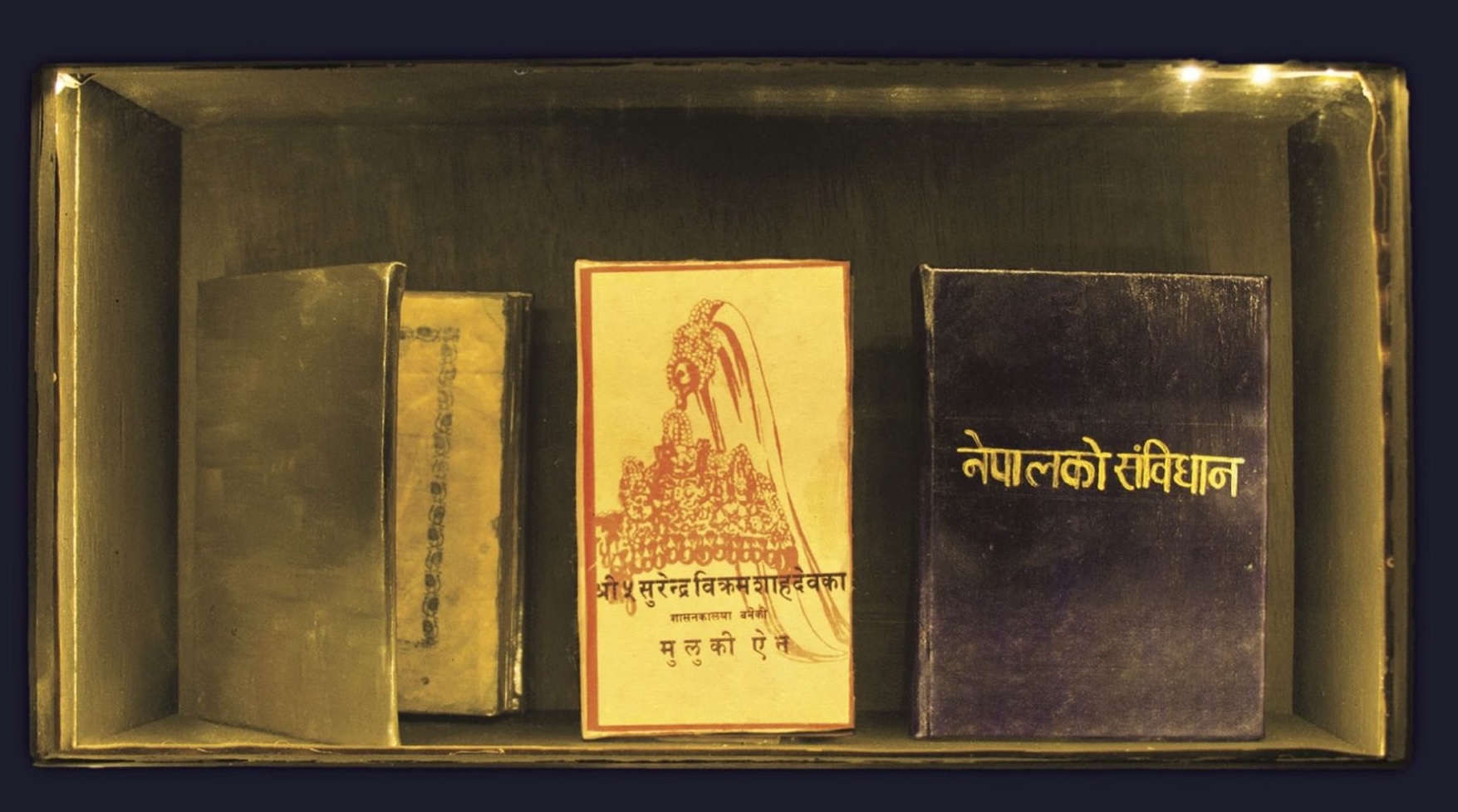

From the transition from the Rana rule to the monarchy to the eventual democratic movements, Nepal’s constitutional framework has evolved through seven major iterations. Each constitution reflects the power plays, reaffirming authority rather than redistributing it.
Nepal’s constitutional journey did not begin with democracy, inclusion, or equality. It began with order. In 1854, early in the Rana regime, the Muluki Ain was proclaimed as a National Legal Code that laid out detailed rules governing society. It defined people not as equal citizens but as categories within a rigid hierarchy. The code structured inter-caste relations and specified punishments for violations, even labelling groups as “enslavable,” “alcohol-drinkers,” and “untouchable.”
The idea of justice was tied to status rather than fairness. Some provisions appear almost surreal today. A person from a so-called lower caste could be fined for acts as minor as spitting toward someone of a higher caste. In more extreme cases, even bodily acts could be punishable if they crossed caste lines. The law did not simply regulate behaviour. It has reinforced inequality and normalised it within the state structure.
Seven Constitutions and Shifting Power
The first constitution of Nepal, the Government of Nepal Act of 1948, came into effect on April 1, 1948. It comprised 68 articles and introduced a formal governance structure. However, it granted sweeping powers to the Prime Minister, who could select members of the legislature and override its decisions. While it appeared to be a step toward modernisation, power remained centralised.
When the Rana regime ended in 1951, there was an expectation that things would finally change. The Interim Government of Nepal Act, introduced under King Tribhuvan, brought change, but not in the way many people expected. Yet the power never went to the people. It shifted back to a monarchy with governance being controlled by the power elites.
Then came 1959, when Nepal held its first parliamentary elections under a new constitution introduced by King Mahendra. For the first time, democracy felt possible. It seemed like public participation might actually lead to real political power. But this phase did not last long.
By 1962, the Panchayat system replaced it, and political parties were banned. Local councils were created, but they operated under strict top-down control. People could participate at a basic level, but they had little influence over actual decision-making.
The People’s Movement of 1990 brought immense public pressure, and, as a result, King Birendra agreed to a constitutional monarchy. It allowed multiparty politics, expanded civil liberties, and created more space for public participation. The monarchy still retained its power and influence, but it was surely a start for a more democratic system.
The real turning point came in 2007, after another jana andolan (People’s Movement). This time, the demand was about reform, but a complete restructuring of the state. Years of public protests and conflict, especially the Maoist insurgency, have shown the inequalities and changes needed in the system.
On May 27, 2008, Nepal was officially declared a federal democratic republic after the first Constituent Assembly meeting, bringing an end to the monarchy, which had shaped the country for centuries.
A decade of the 2015 Constitution
The current constitution, passed in September 2015 with a two-thirds majority, formally established Nepal as a federal democratic republic, promising decentralisation, inclusion, and representation.
The April 2015 earthquake had just left the country devastated, with thousands of lives lost, communities destroyed, and a state already struggling. The constitution itself was being doubted. Madhesi groups and other marginalised communities protested, arguing that federal boundaries and representation did not feel inclusive enough as they lacked the ability to reflect their realities. The tensions further escalated into unrest in the southern terai plains after India imposed an economic blockade as retaliation linked to Narendra Modi’s government.
2015 was a tough year altogether. Even if the constitution promised a more inclusive future, it was born in a moment of crisis and disagreement.
Federalism aimed to bring governance closer to the people. Proportional representation sought to include groups that had long been excluded, such as women, Dalits, Madhesis, and others. Local governments were given authority over areas like education, health, and infrastructure, signalling a shift away from centralised control in Kathmandu.
And to some extent, these changes are visible. There is broader representation in political institutions. Local governments have more presence and responsibility. The structure, at least, looks more inclusive.
Political instability has become the norm, with frequent government changes disrupting the rhythm. Provinces struggle with limited resources and unclear authority. Federalism exists unevenly, working more as a framework than a complete system.
The 2015 Constitution was meant to resolve long-standing tensions in Nepal’s political history. Yet, it has exposed the cracks more clearly. It remains the country’s most ambitious attempt to build an inclusive state, but the future depends on how it is carried forward, contested, and redefined over time.
Woke Consciousness
Because of that gap, a change is brewing, especially among younger people.
Post-Gen Z voters, unlike previous generations, didn’t grow up being defined by monarchy or past political struggles. For them, the country has always been a republic and is evaluated based on outcomes rather than ideals.
Jobs, corruption, governance, and accountability are what matter now.
The shift is already evident. Independent candidates and new political groups are getting more hype. Traditional parties, once unquestioningly loyal, have lost control. Instead, they face scrutiny from a generation that demands results rather than rhetoric.
Earlier transformations were driven by mass movements and visible political upheaval. The current shift is quieter but equally significant, driven by expectation and a growing demand for accountability.
From the Muluki Ain to today’s constitution, Nepal has moved from a system that enforced hierarchy to one that at least aims for equality. Every constitution reflects its time and the societal struggles of its era. The changing geopolitics will show whether it succeeds and how a new generation continues to engage with and redefine the democratic system.
Sudipa Mahato is a junior editor at Nepal Connect.