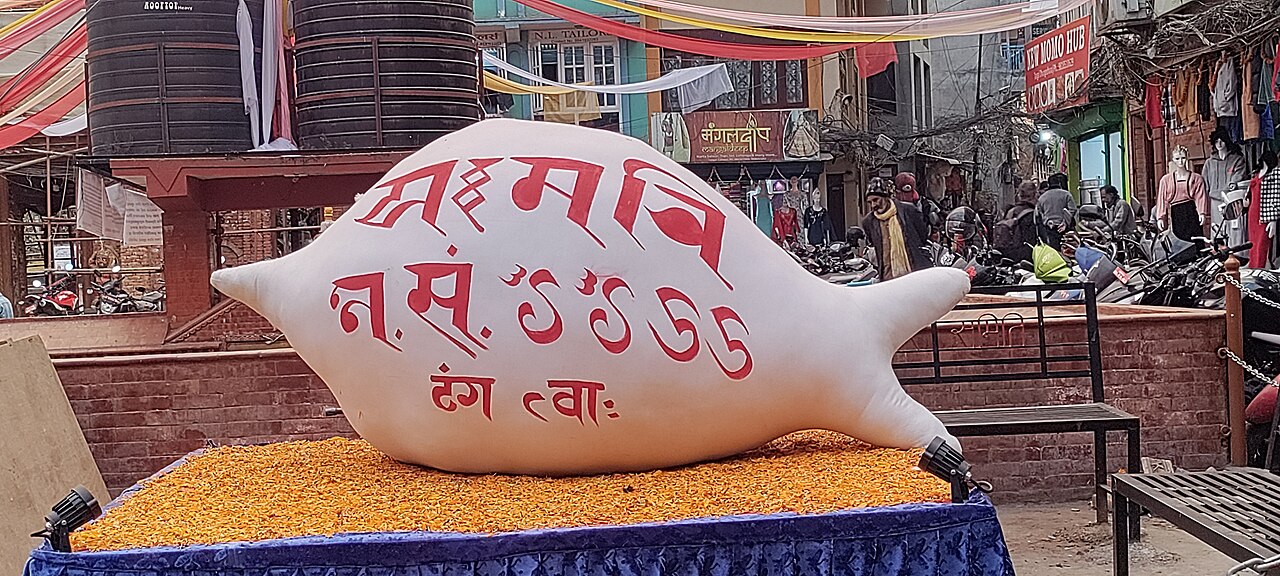
Newars of the Kathmandu valley celebrated the Yomari Punhi on Thursday. Yomari can be written as Ya:mari, Yamari, or Yomari, but regardless of the spelling, it is a beloved delicacy. Every Newari specially farming household prepares Yomari from the year’s newly harvested rice. The rice is ground into flour, mixed with hot water, and kneaded, then shaped into a cone with a pointed end and hollowed out with a finger. The hollow is filled with a mixture of chaaku (molasses) and sesame seeds.The opening is sealed, often forming a tail-like shape resembling a fish’s tail.
It is believed that the winter season begins from this day, and eating warm Yomari helps protect the body from cold. In modern times, Yomari is being prepared with different fillings, such as chaaku (molasses), sesame, and khuwa (reduced milk),
There’s a legend behind the origin of this festival. Long ago, in the Panchal kingdom (present-day Panauti), there was a kind merchant named Suchandra and his wife Krita. His wife always prepared a special bread from freshly harvested rice, chaku (molasses), and sesame to offer to the gods and their neighbour. The neighbours loved the sweet so much that they called it Yomari. In the Nepal Bhasa (Newari language), “Ya:” means liked or favourite, and “mari” means bread, while “Punhi/Purne” means full moon
On the very day of Yomari Punhi Kubera, the god of wealth, visited him in disguise as a beggar. Suchandra’s wife welcomes him warmly and serves him the sacred bread. Delighted, Kubera revealed his identity and gifted her a bimiro (sacred fruit). He also taught her the correct way to worship the grains stored in the granary.
After this incident, the townspeople also began preparing Yomari on Thinla Punhi and offering it to deities and ancestors. The tradition continues today. Once made mostly by Newars, it has now become popular among many other communities.


