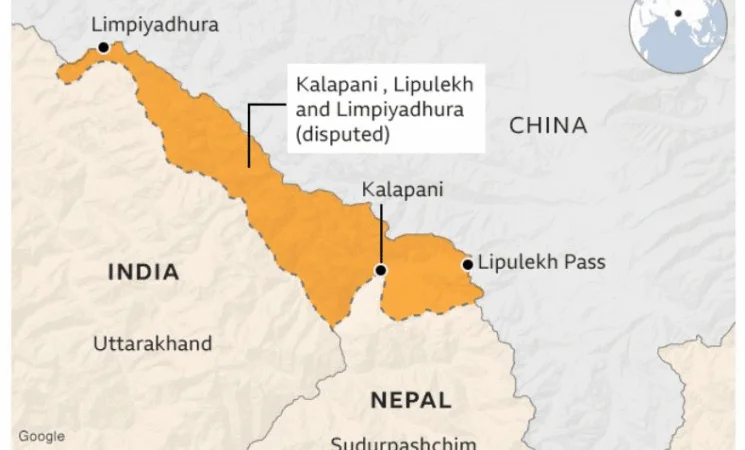

Relations between India and China seem to be improving as they plan to reopen a corridor for traffic between the two countries, a highway over the Lipulekh Pass. There is just one problem. They neglected to involve Nepal in this decision, even though Nepal claims the pass lies on Nepali territory.
Lipulekh is hardly a place to make headlines. Windswept, remote, and thin on oxygen, it has long served as one of the available corridors, albeit not the most suitable for modern traffic. For centuries, traders transported salt, wool, and other commodities on the backs of yaks and donkeys.
Back to 1816
The current discussion about the territorial status of Lipulekh circles back to the Sugauli Treaty. Signed in 1816 between the Kingdom of Nepal and the East India Company, this treaty sharply reduced Nepal’s territory and formalised new borders whose ambiguities have never been fully resolved.
The treaty designated the Kali River as Nepal’s western boundary. On paper, straightforward. In the Himalayas, anything but. It did not define the river’s source, leaving room for competing interpretations that have since hardened into divergent geopolitical positions.
Nepal maintains that the river originates at Limpiyadhura, implying that Lipulekh and Kalapani lie within Nepali territory. India disputes this interpretation, arguing that Nepal’s claims lack historical evidence.
A Dispute That Would Not Stay Quiet
For a long time, however, Lipulekh remained a low-profile irritant in an otherwise well-managed relationship. That changed around 2020, when Indian road construction through the area and Kathmandu’s release of a revised political map displayed the different views of both countries on the territorial status of the area in full sight.
The planned resumption of the Kailash Mansarovar Yatra through Lipulekh, coordinated by India and China, raises the question more immediately. The route is not new, but its revival after a years-long pause has forced Nepal to address road construction activities in the area it regards as part of its own soil.
What Both Governments Say
Nepal’s Ministry of Foreign Affairs, in a statement issued in May 2026, was firm without being combative. Limpiyadhura, Lipulekh, and Kalapani, east of the Mahakali River, are, it is stated, “integral parts of Nepal.” The ministry noted that it had already communicated its position to both India and China through diplomatic channels, and reiterated that it has consistently urged India not to conduct activities through the disputed area. The same position has been formally conveyed to Beijing.
Yet the tone remains carefully calibrated. Nepal’s commitment to resolving the boundary dispute “through diplomatic means”, based on historical treaties and evidence, runs through the entire statement. Nepal must assert sovereignty whilst sustaining functional relations with two powerful neighbours on either side.
India’s Ministry of External Affairs, responding on the same day, emphasised continuity. Lipulekh Pass, it noted, has been used for the Kailash Mansarovar Yatra since 1954 and is therefore not a new development. On Nepal’s territorial claims, New Delhi was more direct: they are “neither justified nor based on historical facts and evidence” and amount to a “unilateral artificial enlargement of territorial claims.” India simultaneously reaffirmed its openness to “constructive interaction” with Nepal on outstanding boundary issues.
The dual posture, rejection paired with an invitation to talk, is characteristic. India treats the matter as settled in principle and negotiable in practice.
The Trijunction Problem
What makes Lipulekh particularly sensitive is its location near the trijunction of Nepal, India, and China. Any development here is rarely purely bilateral. Coordinated India-China activity in an area Nepal considers disputed raises questions that go beyond the territorial: questions of visibility, agency, and whether Nepal’s objections register at all in the calculus of its larger neighbours.
The issue is also not purely strategic. In Nepal, Lipulekh has come to represent something larger: sovereignty, historical justice, national identity. In India, it is framed through continuity of use and administrative fact. These narratives do not easily overlap, and neither side shows much sign of moving towards the other’s reading.
What stands out is not simply that Nepal and India hold different positions, but that they read entirely different texts. Nepal leans on treaty interpretation and historical entitlement. India points to long-standing usage and administrative reality. Both invoke history. Both read it to their advantage.
For now, the path forward is diplomatic, or at least, both governments say so publicly. That gap between stated commitment to dialogue and genuine disagreement on fundamentals is where the story lives. And it is likely to stay there for some time yet.