



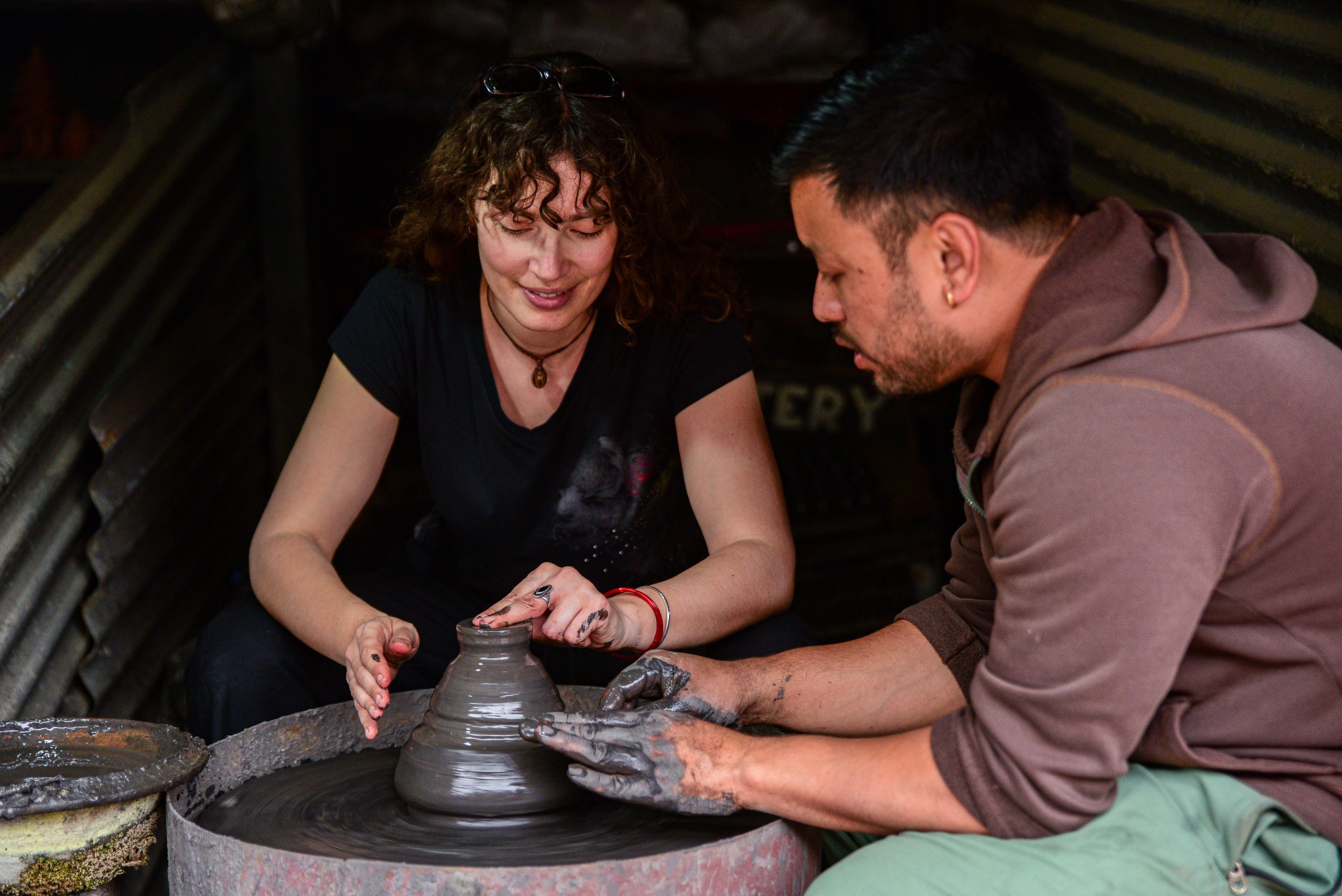
Hands dip into the mud, gliding through the clay. Passers-by stop to watch, and sometimes to try it themselves. This is the pottery square of Bhaktapur, an open courtyard that has functioned as a workshop, marketplace, and living archive since the sixteenth century. The city has long been known as the City of Devotees, but it might just as accurately be called the city of potters.
The conditions for the craft were set long before any living memory. The Kathmandu Valley was a lake until roughly ten thousand years ago. When the water drained, it left behind fertile alluvium ideal for agriculture and, in time, for clay. The oldest recorded pottery finds in Lumbini date back at least 2,600 years. Since then, the skill has moved through families rather than institutions, passed on not through schools but through hands. The Prajapatis, the caste group most associated with the craft, have kept it this way. “My grandfather taught my father, and my father taught me,” says Sajan Prajapati, who has worked the square for decades. “This is our ancestral profession.”
A Calendar Measured in Clay
What makes Nepali pottery more than craft history is its entanglement with everyday life and ritual. Clay pots and earthenware are not decorative objects here; they are functional and, in many contexts, required. During pujas, small ceramic cups hold candles and butter lamps, and at least one clay item is considered compulsory. The traditional Newari rice wine Aila is distilled using a distinctive ceramic setup. Death rituals call for clay utensils specifically, and families often purchase them in bulk. “Many buy around 365 pieces, although larger pots reduce the number required,” says Prajapati. The calendar itself, in a sense, is measured in clay.
That relationship is eroding. Plastic has entered the same spaces that clay once held exclusively, cheaper to buy and easier to reuse. “Nowadays, instead of buying clay items, many prefer plastic buckets,” Prajapati says. The substitution is gradual, but it is accumulating.
The Cost of Raw Material
A supply problem compounds the market pressure. When Prajapati was a child, clay was freely available; Siphadol had its own mines, and potters could take what they needed. Development has since covered those sites with housing. The material must now be brought in from Sankhu and Gokarneshwor by a third party and purchased by the potters who once sourced it themselves.
Black clay, which must be dug from ten to twelve feet below the surface and processed before use, costs roughly 0.33 USD per unit. Higher grades cost more and withstand greater heat: black clay tolerates up to 800°C, white clay up to 1,500°C, and stone glaze up to 2,500°C. The quality of the clay determines the quality of the final piece, and quality costs money that smaller operations are increasingly unable to absorb.
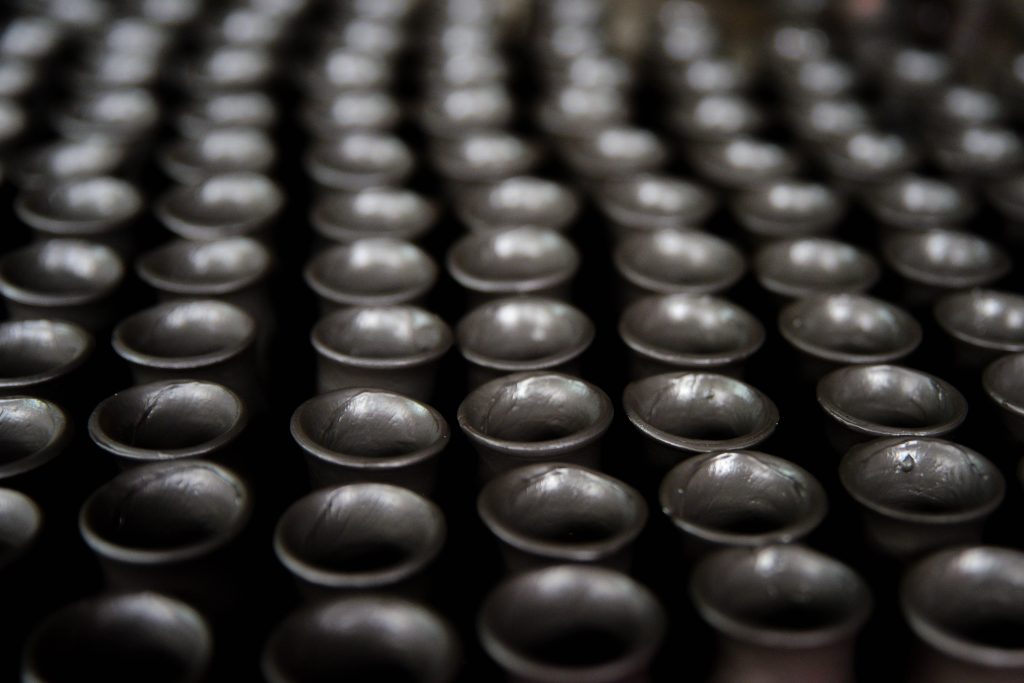
Photo: Pratikshya Bhatta
A Square Half-Empty, and What Is Filling It
In 1985, an estimated 600 potters worked in the square. The figure has dropped sharply since. “Earlier, the whole ground used to be filled with people working,” says Prajapati. “Now, it’s mostly empty.” Younger generations, facing income uncertainty and better options elsewhere, have largely not replaced those who stepped away.
Technology has helped in ways that are easy to underestimate. The pottery wheel was once rotated manually with a wooden stick, a slow and physically demanding process. Electric wheels have changed the pace of work considerably without displacing the fundamental skill. In Bhaktapur, at least, modernisation has served the craft rather than threatened it.
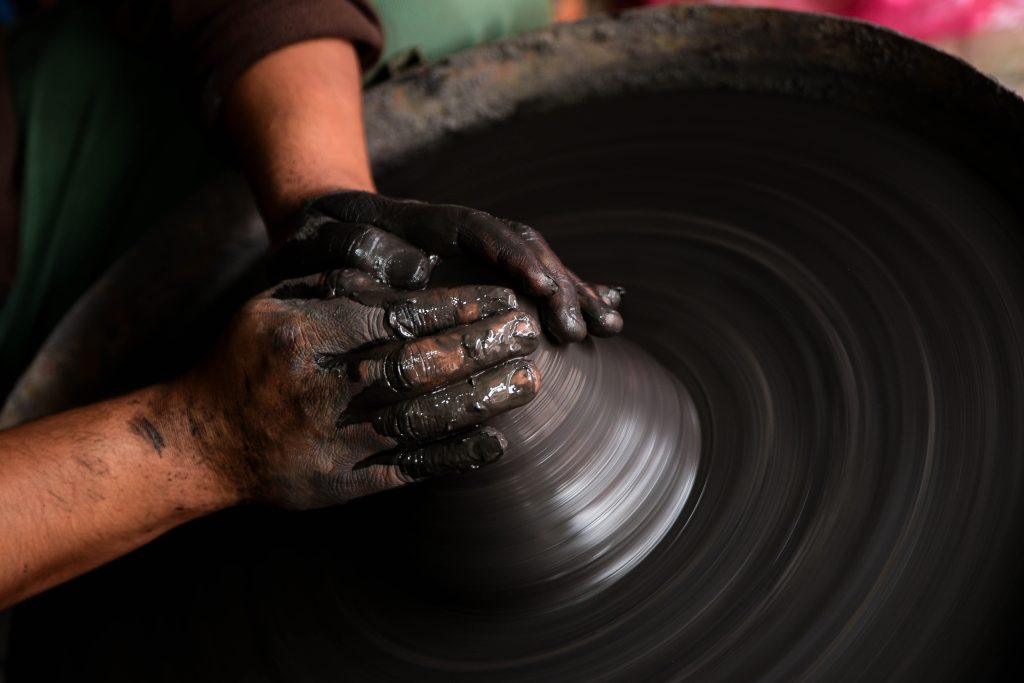
So, more quietly, there has been a shift in who is learning. Pottery was historically men’s work; women participated in the later stages, drying and colouring, but rarely at the wheel. That division is breaking down. Women-led ceramic studios and training spaces have appeared across the Kathmandu Valley. Interest in learning the craft has grown in recent years, drawing visitors from abroad alongside local students. Studios now charge for tuition where teaching was once free, the rising cost of clay making informal instruction harder to sustain. But the curiosity is genuine, and it is arriving from unexpected directions.
Prajapati is matter-of-fact about his own intentions. Whether or not the next generation takes up pottery as a profession, he will make sure the skill is passed on. It would be a shame, he says, to let it fade when people are travelling from other countries to learn it. Even as a hobby, it deserves to survive. The square may be quieter than it once was, but it is not yet finished with the work.

